


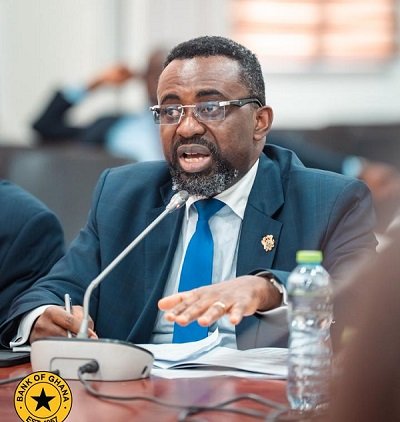
THE Governor of the Bank of Ghana (BoG), Johnson Pandit Asiama, says the decision to rebalance Ghana’s gold reserves did not amount to a loss of national assets, but rather a restructuring of the composition of the country’s international reserves.
According to him, the decision to convert the country’s gold holdings into foreign exchange was a standard practice intended to ensure a balanced and diversified reserve portfolio.
“Ghana’s gold reserves remain part of our national reserves. What changed was the composition of those reserves,” he stated.
Dr Asiama made this known when he appeared before the Parliamentary Select Committee on Economy and Development at Parliament House yesterday.
He said the measure formed part of prudent reserve management aimed at strengthening Ghana’s external buffers and ensuring that the country’s reserves remain liquid and readily available when needed.
Dr Asiama said the BoG had significantly increased its gold holdings through the Domestic Gold Purchase Programme introduced in 2021.
He said before the programme, the Bank held about 8.7 tonnes of gold, but through sustained purchases, the holdings rose to more than 40 tonnes by October 2025.
However, he noted that a sharp rise in global gold prices significantly increased the value of the Bank’s gold portfolio.
Between January and October 2025, he said, global gold prices rose by about 62 per cent, resulting in gold accounting for about 42 per cent of Ghana’s gross international reserves.
Dr Asiama explained that although gold remained an important reserve asset, maintaining such a large share of reserves in a single asset class posed concentration risks.
He said international reserve management practices emphasised diversification to ensure stability and resilience.
“International reserves must not only be valuable but also liquid, diversified and readily available when needed,” he added.
The Governor explained that for countries such as Ghana, international reserves were critical for stabilising the foreign exchange market, financing essential imports and responding to external economic shocks.
He said the Bank therefore undertook a measured portfolio rebalancing to restore an appropriate balance between gold and foreign currency assets.
Dr Asiama stressed that central banks manage reserves with the objective of ensuring safety, liquidity and diversification, rather than speculating on short-term price movements.
He said the foreign exchange obtained from the transaction remained fully part of Ghana’s international reserves and continued to be actively invested to generate returns while strengthening the country’s external buffers.
Dr Asiama said gross international reserves increased to about $13.8 billion by the end of 2025, representing about 5.7 months of import cover.
Touching on the broader economic outlook, Dr Asiama said the policy measures implemented by the BoG had contributed to improving macroeconomic conditions.
He said inflation, which stood at 23.8 per cent at the end of 2024, had declined sharply to 3.3 per cent as of February 2026.
Dr Asiama noted that the improvements reflected the effectiveness of the policy measures introduced by the central bank following the economic challenges associated with the Domestic Debt Exchange Programme.
BY BENJAMIN ACTON TETTEY
Join our WhatsApp Channel now! https://whatsapp.com/channel/0029VbAjG7g3gvWajUAEX12Q
Follow our WhatsApp Channel now! https://whatsapp.com/channel/0029VbAjG7g3gvWajUAEX12Q

