


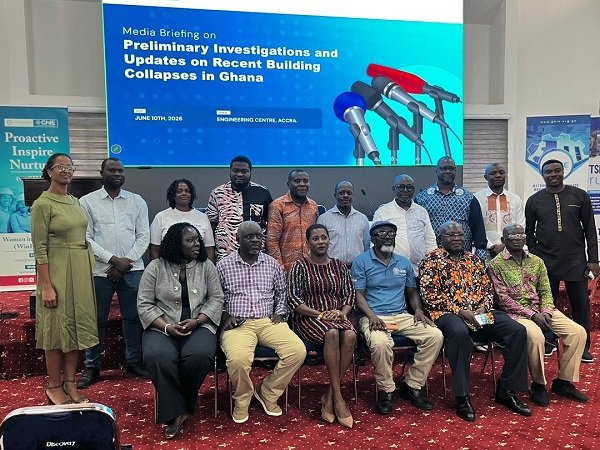
Regulatory authorities have been urged to strictly enforce existing building regulations to curb the increasing incidence of building collapses across the country.
The call followed preliminary investigations into recent building failures which revealed widespread disregard for permit requirements, approved building standards and professional supervision, as well as lapses in regulatory enforcement.
The Chairman of the Structural Subdivision of the Ghana Institution of Engineering (GhIE), Joshua Alotey, made the call at a joint press conference by the GhIE, the Institution of Engineering and Technology Ghana and the Local Government Service Engineers Association yesterday in Accra.
The briefing presented preliminary findings from investigations into recent building collapses, including incidents at Adenta on June 5, 2026, and Newtown on March 29, 2026.
Mr Alotey said investigations had revealed that some collapsed buildings were erected without the involvement of qualified engineers, exposing a dangerous pattern of construction without proper design, supervision and certification.
He said investigators also identified serious deficiencies in foundation design and geotechnical compliance, including shallow foundations, inadequate reinforcement and non-compliance with engineering standards.
According to him, some construction projects proceeded without approved architectural drawings, structural designs or valid building permits, while official stop-work orders issued by Metropolitan, Municipal and District Assemblies (MMDAs) were ignored.
The investigations further uncovered cases where additional floors had been added to existing buildings without professional assessment or regulatory approval, imposing loads that the original structures had neither been designed nor assessed to carry.
Mr Alotey said poor quality concrete, inadequate reinforcement detailing, discontinuous load bearing columns and insufficient structural support systems were among the structural deficiencies observed at several collapse sites.
He noted that abandoned and deteriorating buildings also posed significant safety risks to surrounding communities, particularly children and unsuspecting residents.
While heavy rainfall, rising groundwater levels and strong winds had coincided with some incidents, he stressed that these were not the root causes of the collapses but merely exposed pre-existing weaknesses in poorly designed or poorly constructed structures.
Mr Alotey also expressed concern about the growing practice of converting residential buildings into churches, schools, warehouses and commercial facilities without proper structural assessment, warning that such changes could compromise structural integrity and endanger lives.
As part of measures to improve building safety, he called for stricter enforcement of existing regulations, mandatory stage by stage inspections, certification of construction artisans and a six to 12 month structural certification exercise for buildings of two storeys and above.
He said owners of such buildings should be required to submit architectural and structural drawings and assessment reports for review, while unsafe structures should be restricted, partially closed or evacuated until remedial works were completed.
The Greater Accra Regional President of the Local Government Service Engineers Association, Vincent Blay Quarshie, said many developers contributed to the problem by bypassing established procedures and engaging artisans instead of qualified built environment professionals.
He explained that the building permit acquisition process was designed to ensure that structures were properly designed, assessed and monitored before and during construction.
Mr Quarshie said developers were required to obtain approval for their building plans and notify the Head of Works before construction commenced to enable engineers undertake inspections at critical stages of the project.
He stressed that soil testing and geotechnical investigations were essential to determining whether land could safely support a proposed structure and urged developers to engage qualified professionals from the design stage through construction and supervision.
BY STEPHANIE BIRIKORANG
Follow our WhatsApp Channel now! https://whatsapp.com/channel/0029VbAjG7g3gvWajUAEX12Q

