


The Institute of Economic Affairs (IEA), an economic and governance policy think tank, has called on the government not to renew the mining lease of Gold Fields’ Tarkwa mine when it expires in April 2027.
Instead, the institute argued that Ghana should take advantage of the expiration to channel mining revenues into national development and the transformation of mining communities.
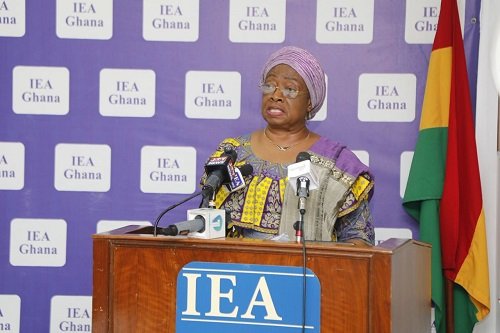
At a press conference in Accra yesterday, former Chief Justice Sophia Akuffo expressed concern about the poor state of development in mining communities such as Tarkwa, despite more than three decades of mining operations.
She lamented that many communities within the mining enclave continued to struggle with deteriorated roads, inadequate healthcare infrastructure, limited educational facilities, and widespread socio-economic challenges, including unemployment and underemployment.
“After more than three decades of mining activity in Tarkwa, many communities within the enclave continue to grapple with deteriorated roads, inadequate healthcare infrastructure, limited educational facilities and widespread socio-economic deprivation, including rampant unemployment and underemployment,” she said.
Justice Akuffo noted that the expiration of Gold Fields’ current lease presented Ghana with what she described as a “rare and historic opportunity” to reclaim effective ownership and strategic control of the Tarkwa mine, especially at a time when global gold prices remain high.
She described Gold Fields’ attempt to secure a 20-year lease extension as being “inimical to Ghana’s long-term economic and strategic interest.”
She further emphasised the need for Ghana to adopt a model that guarantees full ownership of its natural resources in line with national interest.
She referenced the United Nations General Assembly Resolution and the African Charter on Human and Peoples’ Rights, among other international frameworks, which affirm the sovereign right of nations to control and utilise their natural resources for the benefit of their people.
According to her, Ghana’s greatest comparative advantage lies in its abundant natural resources.
She said unlocking their full potential would require a shift towards national ownership, responsible extraction, local value addition, and the export of finished or semi-finished products to generate higher revenue and foreign exchange.
Justice Akuffo added that the IEA believed Ghana should retain full sovereignty over its mineral resources, while engaging local and foreign private sector actors strictly through service arrangements that preserve national benefits.
Former Speaker of Parliament, Prof. Aaron Mike Oquaye, said the IEA’s position was non-partisan.
He cautioned that Ghana risked remaining in “perpetual poverty” if government failed to resist pressure to extend or renew the lease.
The Board Chairman of the IEA, Mr Charles Mensa, also attributed Ghana’s challenges in achieving full control of its natural resources partly to what he described as a mindset that favours foreign participation in key sectors.
He urged Ghanaians to rethink that approach and take a stronger interest in decisions concerning the country’s natural resources and long-term economic future.
BY BENJAMIN ARCTON-TETTEY
Follow our WhatsApp Channel now! https://whatsapp.com/channel/0029VbAjG7g3gvWajUAEX12Q

