


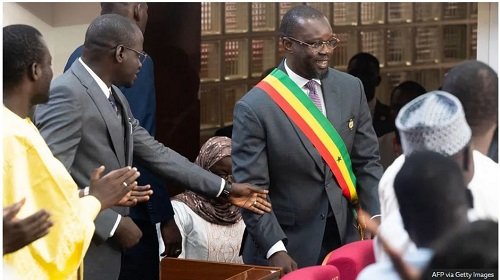
Senegal’s former Prime Minister Ousmane Sonko, who was dramatically sacked on Friday by the president, has been elected Speaker of the national parliament, setting up a possible source of conflict at the top of Senegalese politics.
The West African nation’s current crisis follows months of tension between Sonko and his one-time ally President Bassirou Diomaye Faye.
Parliament’s previous Speaker stepped down on Sunday to make way for the former prime minister, who is a popular figure and whose Pastef party has a majority of the seats in the National Assembly.
On Monday, Faye appointed economist Ahmadou Al Aminou Lo to replace Sonko as prime minister.
Relations between the president and his now-former prime minister had been deteriorating for months, with Sonko openly criticising Faye for his handling of Senegal’s debt problems.
“What is at stake is the relationship between morality and politics,” Sonko has since said, promising not to use his new position to “to fight against anyone” and instead ensure that parliament acts in Senegalese citizens’ best interests.
Yet Sonko has also said that his dismissal as prime minister does not mean his political career was over.
Sonko’s new role as Speaker – the second highest political position in the country – could limit President Faye’s ability to manoeuvre if he fails to secure parliamentary support for his policies, analysts say.
The president cannot dissolve parliament until at least two years after the last election – that means any move to prematurely end the mandates of lawmakers before November this year would be considered invalid.
The rift between Faye and Sonko further raises uncertainty over the political future of the debt-challenged country.
The 51-year-old ex-prime minister commands massive support across the country, especially among young people, and within his party, Pastef.
“Pastef remains open to responsible discussion that sets aside egos to complete this term in the best possible conditions,” he said.
The size of Senegal’s public debt – now standing at 132 per cent of GDP – has been a cause of major friction, with Faye seen as being more receptive to the belt-tightening polices of the International Monetary Fund (IMF). –BBC
Oil prices drop as traders look for US-Iran talks progress
Oil prices fell around three per cent yesterday as traders weighed up progress in U.S.-Iran peace talks against renewed hostilities.
Brent crude futures fell $2.67, or 2.68 per cent, to $96.91 a barrel by 1139 GMT, while U.S. West Texas Intermediate (WTI) crude lost $3.43, or 3.65 per cent, to $90.46 a barrel.
The losses dented Brent’s gains from Tuesday.
“There has been palpable progress towards ending the crisis, and an increasing number of ships are transiting the critical chokepoint. This is why the downward pressure has resumed,” PVM analyst Tamas Varga said, referring to the Strait of Hormuz, key to global oil and gas flows.
July Brent futures rose 3.6% in the previous session after the U.S. carried out new strikes in Iran, hurting hopes that had risen over the weekend that Washington and Tehran would reach a peace deal.
“Hopes for a framework agreement between the U.S. and Iran to end the conflict have been somewhat dampened by the recent U.S. strikes on Iranian missile sites and vessels that were allegedly attempting to lay mines in the Strait of Hormuz,” Commerzbank analysts said on Wednesday.
“Nevertheless, confidence remains high among market participants,” they added.
Iran said on Tuesday that the U.S. had violated a ceasefire by striking targets near the Strait of Hormuz, while Washington said its strikes were defensive in nature.
Israel ramped up bombing in Lebanon on Tuesday, further straining peace efforts.
After an April ceasefire in the three-month-long conflict, both sides indicated they had made progress in talks toward reopening the Strait.
News that some LNG tankers have passed through the strait in recent days lifted expectations that the waterway might reopen soon, which would add to global supply. –Reuters
Follow our WhatsApp Channel now! https://whatsapp.com/channel/0029VbAjG7g3gvWajUAEX12Q

