


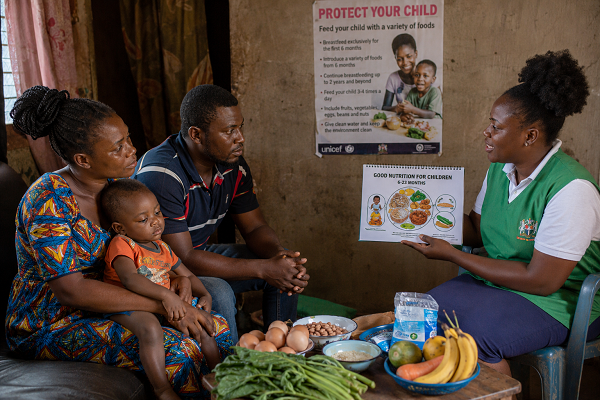
Every morning before sunrise in Ashalaja, a community in Accra, 43-year-old Sarah Yeboah wakes up to the same struggle. She lights her charcoal stove and prepares porridge while carrying her 14-month-old baby boy on her back. The child cries often. His arms are very thin, and his body is smaller than babies his age.
A few weeks earlier, nurses at Kwame Anum Health Centre, also in Ashalaja, had cautioned her to take the feeding of her baby seriously. They told her that her baby was severely malnourished, but for Madam Yeboah, the nurses’ advice was not surprising to her. She knew the problem was real.
According to her, her child’s feeding pattern has not been the best. However, her failing finances could not support her in providing the best possible nutritious meals for her growing child. She has lost her capital for petty trading and now remains unemployed.
“My husband complains bitterly about the cost of the child’s food. He says eggs, fruits and milk are too expensive. For him, porridge was enough when we were growing up,” she said quietly.
In their small compound house, her husband controls the money while she takes care of the children. They have five other children.
For months, she has observed that her child has been losing weight, a condition she knew was due to poor feeding. However, her husband has refused to heed her advice to provide money to buy nutritious ingredients such as eggs, beans, fruits and milk for the preparation of the child’s meals. It was the reason she was not surprised when the nurses told her that her child was suffering from severe malnutrition.
Malnutrition at homes
At the Oduman hospital in the Ga West municipality, Senior Community Health Nurse Felicia Tetteh says such cases are becoming common.
She remembers one particular case clearly. A two-year-old boy was diagnosed with severe acute malnutrition. Health workers advised the mother to feed him eggs, beans, milk and fruits to help him recover. But weeks later, the child returned to the hospital in worse condition.
“The mother told us she tried, but her husband refused to give her money for the child’s meals,” Nurse Tetteh said. According to her, the woman had no job and depended solely on her husband for survival.
In another case, she narrated, a young mother whose child was also severely malnourished repeatedly told health workers that she understood the feeding advice but had no money to follow it. Her husband controlled the little income in the home and did not believe the child needed special foods.
“The child needed eggs, beans and milk, but the father would not support it,” Ms Tetteh explained. She added that the child’s condition worsened before help finally came. For Ms Tetteh, even though the named food ingredients are not too expensive, so to speak, many families struggle to purchase them, contributing to their children’s malnutrition in the process.
According to the nurse, many mothers face similar struggles quietly in their homes across the country.
The national picture
The story of Sarah Yeboah, as Ms Tetteh noted, reflects the situation in many homes in Ghana where mothers, especially nursing mothers, struggle to feed their babies nutritious meals.
According to figures shared during a nutrition engagement programme organised by Women, Media and Change together with the Eleanor Crook Foundation and the Clinton Health Access Initiative under the Nourish Ghana Project, Ghana records more than 68,000 cases of severe acute malnutrition every year. Yet many affected children do not receive treatment early enough.
Data presented at the engagement showed that only 16 per cent of affected children were diagnosed and admitted for treatment in 2024.
For Abdul-Fatahi Adam, a Senior Analyst for Child Health at the Clinton Health Access Initiative, the situation remains worrying.
He explained that about 51 per cent of pregnant women in Ghana were reported anaemic in 2024, with 11 per cent of babies born with low birth weight in the same year, increasing their risk of sickness, developmental problems and death.
UNICEF also estimates that nearly one in five Ghanaian children suffers stunted growth because of poor nutrition. Health experts warn that poor nutrition during the first two years of a child’s life can affect brain development, learning ability and overall growth.
Why fathers must be included
Mrs Linda Ofori-Kwakye, a Public Health Nutrition Officer at the Ga West Municipal Health Directorate, says one major problem is that many nutrition programmes focus mainly on mothers. “But in many homes, fathers control the money and food decisions,” she explained.
According to her, many mothers attend child welfare clinics regularly but are unable to follow feeding advice because they have little control over household finances.
“Nutrition should not be left to mothers alone. It is the responsibility of both parents,” she stressed.
Corroborating this narrative where fathers are excluded from the nutrition loop, a 34-year-old mechanic, Kwesi Mensah, admitted that he once believed child nutrition was only a woman’s responsibility until his daughter was admitted to the hospital and they were told the child was suffering from severe anaemia.
“I never followed my wife to the clinic because I thought those things were for women,” he said. He added, “When I saw how weak she was, I realised I also had a responsibility.”
Today, Mensah helps provide fruits, vegetables and other healthy foods for the family.
Dorcas Ahenkrah, a nutritionist at MK Medical Centre, expressed concern about leaving fathers out of nutrition education programmes.
“We keep teaching mothers, but many mothers cannot make decisions alone. If fathers are not involved, progress becomes difficult,” she said.
Culture and food beliefs
Community leaders say cultural beliefs also contribute to the problem. Assemblyman Nii Kojo Ashitey of Ashalaja said many men were raised to believe feeding children is only the mother’s responsibility.
“Some fathers think once they provide money for food, their work is done,” he said.
He also said some families still believe children should not eat eggs or certain nutritious foods because of old myths.
Pastor Samuel Tetteh of Christ Victory Chapel in Akraman in Ga West said churches must help educate parents on proper nutrition.
“Many children are suffering quietly because parents lack knowledge and support,” he said.
Gaps in nutrition support
The Ministry of Health, the Ghana Health Service and development partners have introduced several nutrition programmes over the years. However, major gaps still remain.
The Clinton Health Access Initiative has explained two important interventions, namely Ready-to-Use Therapeutic Food (RUTF) and Multiple Micronutrient Supplements (MMS), which could significantly reduce child deaths and improve maternal health if fully funded and made available across the country.
RUTF is a peanut-based food used to treat severely malnourished children at home without long hospital stays.
MMS contains essential vitamins and minerals for pregnant women and has been shown to reduce low birth weight, stillbirths and premature births. Despite the benefits, access to these interventions remains limited.
Figures presented during the nutrition engagement showed that although admissions for severe acute malnutrition increased in 2025, only 23.3 per cent of identified cases received RUTF treatment in the first quarter of 2026.
The cure rate also dropped to 63 per cent, far below the international target of 85 per cent.
Experts say financing shortages, weak community awareness and low male involvement continue to slow progress.
Calls for stronger action
Dr Efua Hammond, a nutrition policy analyst at the University of Ghana, said future nutrition campaigns must target fathers as much as mothers.
“We cannot talk about child nutrition without involving fathers because many of them control food spending in the home,” she said.
She called for more education for fathers during antenatal and child welfare clinics, as well as community campaigns. Additionally, she called on churches and traditional authorities to support efforts to educate fathers on nutrition for their children.
A small change at home
For Sarah Yeboah, things only changed after her baby was admitted to the hospital.
She says the experience changed her husband’s attitude, saying, “He now buys eggs, milk and groundnuts for the baby.”
But health workers say many children across Ghana are still waiting for that same support Sarah Yeboah’s husband is now providing at home. They say the fight against child malnutrition will not be won only in hospitals or clinics and requires the cooperative support of both the father and mother at home.
By Benedicta Gyimaah Folley
Follow our WhatsApp Channel now! https://whatsapp.com/channel/0029VbAjG7g3gvWajUAEX12Q

