


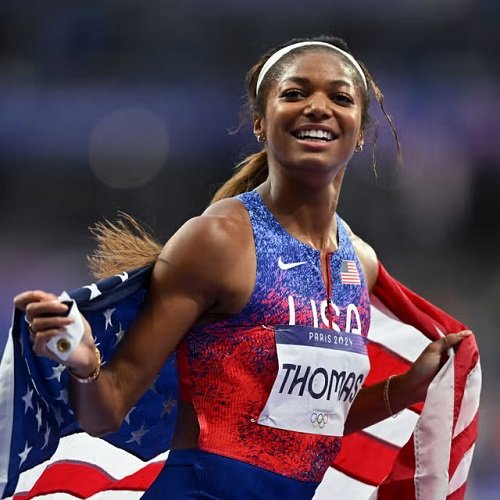
The American sprinter and triple Olympic medallist has sparked a debate in athletics by calling for lifetime bans for coaches linked to doping, a stance that questions the ethics of the sport and brings to the forefront the responsibility of those who guide athletes beyond their achievements.
Last week, the runner posted a strong message in an Instagram story on her profile: “Doping coaches should be banned for life from coaching in the sport. Whether you were banned while competing as an athlete or caught distributing as a coach (for some, both). Idc idc idc. If you train under a coach who is known for doping (once, twice, or even three times for some), you are complicit. That’s my stance.” Gabby Thomas is clear that any collaboration with sanctioned coaches implies direct complicity, regardless of the number of violations committed.
The post sparked widespread reaction on social media. As reported by the CBC news outlet, the sprinter’s message fuelled speculation about exactly whom Thomas was targeting with her criticism of ‘doping coaches’. Several commentators concluded that it might have been a dig at Dennis Mitchell, who coaches a large group of superstars, including Melissa Jefferson-Wooden, the current world leader in the women’s 100 metres. Other athletics fans have praised Thomas’s boldness, noting that few active athletes have taken such a direct and unequivocal stance.
Currently, athletics lacks a uniform global rule to prevent coaches with a doping history from returning to the sport. The World Anti-Doping Code provides for sanctions against athlete support personnel, including coaches, but enforcement largely depends on national federations. This has allowed some displaced coaches to simply move to new training environments beyond the reach of stricter governing bodies.
The Athletics Integrity Unit’s database of sanctioned coaches represents a step towards transparency, but it remains incomplete. In some circles, it is known that athletes continue to work with coaches who have doping records, which highlights the existing gaps in global oversight and control of the sport.
With the opening of qualification periods for the 2025 World Championships and the 2026 Olympic Games, the relationship between athletes and coaches is once again under scrutiny. Pressure on regulatory bodies and federations could increase, and Thomas’s message contributes to a necessary debate on ethics and transparency in sport.
The sprinter’s proposal not only questions past practices but also opens the discussion on the limits of tolerance and complicity in contemporary athletics. The demand for permanent sanctions for coaches with a doping history raises an ethical and regulatory dilemma that still lacks a clear global response, although it has succeeded in focusing media attention on the integrity of the sport and the importance of stricter oversight mechanisms.
The impact of these statements could influence future policies and decisions by national and international federations, reinforcing vigilance over the relationship between athletes and coaches and underlining the need to maintain the credibility of athletics in the face of doping scandals that have marked its recent history.-.insidethegames
CAPTION
Gabby Thomas