


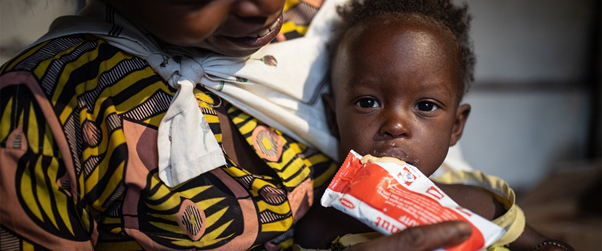
At the nutrition ward of the Ahmadiyya Muslim Hospital at Kaleo in the Nadowli-Kaleo District of the Upper West Region, mothers sit quietly beside children whose bodies have become frighteningly small.
Some of the children are too weak to cry. Others stare blankly into space, their thin arms resting motionless on their mothers’ laps.
The room is heavy with silence, interrupted only by the occasional cough or the rustle of wrappers from sachets of therapeutic food.
For many of these children, survival depends on a peanut-based paste known as Ready-to-Use Therapeutic Food (RUTF) — a nutrient-dense, lifesaving product capable of reversing severe acute malnutrition within weeks.
Yet in Ghana, access to this treatment often depends not on need, but on whether donor funding is available, raising concerns over what experts describe as a growing nutrition financing crisis threatening the lives of thousands of pregnant women and children.
Severe acute malnutrition (SAM) is one of the deadliest forms of undernutrition among children. Characterised by severe wasting, very low weight-for-height or fluid retention, the condition drastically weakens immunity and increases the risk of death from common childhood illnesses.
Globally, an estimated 19 million children under five suffer from SAM, contributing to roughly 400,000 preventable child deaths every year.
In Ghana alone, about 68,517 children develop the condition annually, yet only about 15 per cent receive treatment, according to health authorities.
Experts say admissions for SAM treatment have tripled in recent years, while cure rates continue to decline. Out of a target of 25,000 children, only 14,385 reportedly received RUTF treatment.
For years, Ghana’s nutrition response has leaned heavily on donor-funded programmes and development partner support.
RUTFs — globally recommended for treating severe acute malnutrition — remain largely dependent on external financing instead of a stable domestic funding system.
“Whenever funding delays occur or supplies run low, treatment pipelines weaken, health facilities experience stock-outs and vulnerable children are left exposed,” says the Deputy Director of Nutrition at the Ghana Health Service, Dr Olivia Timpo.
“Without reliable commodities, guidelines cannot translate into treatment or prevention,” she says.
Ghana has several nutrition-related policies and strategies. These include the National Nutrition Policy, the Food and Nutrition Security Policy and the Maternal and Child Health Policy, alongside treatment guidelines and specialised training programmes aimed at improving the nutritional status of women and children.
Yet outcomes remain troubling.
According to experts, Ghana’s nutrition emergency extends far beyond visibly malnourished children. It often begins long before birth.
The 2022 Ghana Demographic and Health Survey (GDHS) showed that 51 per cent of pregnant women attending health facilities were anaemic.
During pregnancy, a woman’s body requires additional iron, vitamins and nutrients to support the growth of the unborn child. Without adequate nutrition, both mother and baby become vulnerable to serious complications.
The consequences are devastating — preventable maternal and infant deaths, low birth weight, premature births, impaired brain development, poor learning outcomes and higher long-term healthcare costs.
Experts say the cycle of poor maternal nutrition continues to fuel Ghana’s broader malnutrition burden, reinforcing the need to intervene early, beginning from pregnancy.
Although Ghana is transitioning from Iron-Folic Acid (IFA) supplementation to Multiple Micronutrient Supplements (MMS), a newer World Health Organisation (WHO) recommendation containing 15 essential vitamins and minerals for pregnant women, the intervention faces a familiar challenge: dependence on donor support.
“MMS shifts nutrition financing from late treatment to early prevention in pregnancy,” Dr Timpo explains.
Yet, together with RUTFs, both interventions remain “highly dependent on project or partner financing rather than a predictable domestic budget line.”
In a country already burdened by rising healthcare costs and increasing cases of non-communicable diseases, experts argue that prevention is no longer optional but economically necessary.
Across Africa and Asia, a growing number of countries are increasingly shifting nutrition interventions from donor-driven programmes to domestically financed systems. Some are adopting co-financing arrangements and investing in local production models for RUTFs and MMS to reduce dependence on unpredictable external aid.
Experts believe Ghana now faces a similar test, whether it can move beyond policy promises to building a sustainable nutrition financing system capable of protecting pregnant women and children.
Last year, Ghana made 10 commitments at the global Nutrition for Growth (N4G) Summit aimed at accelerating action against malnutrition by 2030.
Among the commitments was a pledge to spend at least six million dollars annually from 2026 on essential nutrition commodities, including RUTFs and MMS.
Although some progress has been made including integrating the N4G commitments into the country’s 2026-2029 National Development Policy Framework, developing planning toolkits and producing baseline reports to justify increased nutrition investment, funding gaps remain a major obstacle.
Nutrition experts believe the uncapping of the National Health Insurance Scheme (NHIS) presents a major opportunity for Ghana to take ownership of its nutrition response by integrating RUTFs and MMS into the scheme’s benefit package.
“NHIS integration is the bridge between policy intent and routine service delivery,” Dr Timpo insists.
“Although the scheme pays for services and medicines, these key nutrition commodities must be explicitly positioned to be reimbursed to ensure access to care is sustained.”
Senior Analyst for Child Health at Clinton Health Access Initiative, Adam Abdul-Fatahi, says including RUTFs and MMS under the NHIS could provide a sustainable solution to Ghana’s current nutrition financing challenges.
“It will remove the cost barrier, ensure domestic ownership, stabilise the supply chain and drive down the cost of procurement of these commodities,” he explains.
To him, Ghana’s malnutrition crisis is no longer merely a public health problem; it is increasingly a financing crisis.
“Ghana has policies and the political will. What’s needed now is to convert that into financing, and NHIS inclusion is the lever that turns commitment into coverage for Ghana’s children and mothers,” he says.
With barely four years remaining to meet the Sustainable Development Goals (SDGs) and N4G targets, eyes are on Ghana to translate its commitments into measurable action.
The stakes are high but the long-term benefits in health and productivity are profound.
“Investing in nutrition is catalytic,” says Planning Analyst at the National Development Planning Commission, Nii Odoi Odotei.
“Every dollar invested in nutrition results in 23 dollars earned. It also reduces losses to GDP caused by poor education, ill health and low productivity.”
He urged government to prioritise innovative and sustainable ways to finance nutrition interventions.
“We must pay now for nutrition or pay later for illness, poor learning and lost productivity,” Mr Odotei warns.
For thousands of Ghanaian children fighting silent battles against hunger and malnutrition and pregnant anaemic women, the issue is not about policies or summits.
It is about whether lifesaving nutrition commodities will be available when they need it most.
The time to invest is now.
BY ABIGAIL ANNOH
Follow our WhatsApp Channel now! https://whatsapp.com/channel/0029VbAjG7g3gvWajUAEX12Q

