


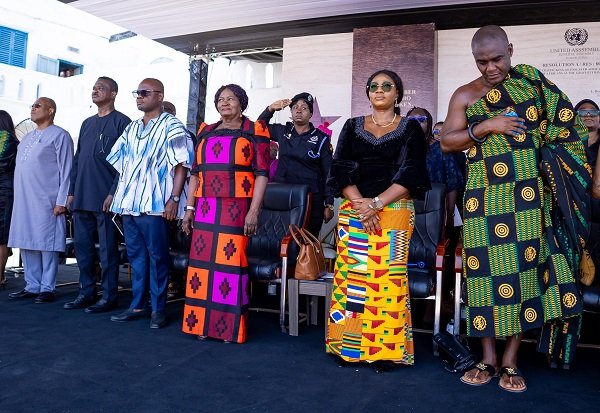
The Vice President, Professor Naana Jane Opoku-Agyemang, has called for concrete action on reparatory justice, saying international recognition of the transatlantic slave trade as a crime against humanity must not end with a resolution.
She said the next step should focus on education, preservation, restitution, legal pathways and sustained international engagement.
Professor Opoku-Agyemang made the call at a memorial service held in Cape Coast in remembrance of victims of the transatlantic slave trade, as part of activities marking the Oguaa 2026 Fetu Afahye.
She said the United Nations General Assembly’s adoption of Resolution 82/50 on March 25, declaring the trafficking of enslaved Africans and the system of racialised chattel enslavement of Africans the gravest crime against humanity, was an important achievement.
According to her, Ghana led the efforts that resulted in the resolution, with support from the African Union, Caribbean countries and other partners.
The Vice President said the scale of the slave trade must be fully understood, noting that Africans were captured, commodified and transported across the Atlantic and other seas for centuries.
She said families and communities were broken apart, while millions died during capture, detention and transportation.
Those who survived, she said, were subjected to systems designed to deny their humanity.
Professor Opoku-Agyemang also called for greater recognition of African resistance to slavery.
She said Africans were not only victims of enslavement but also resisted capture, defended their communities, escaped, organised and fought to preserve their freedom.
She said evidence of that resistance could still be found in places such as Cape Coast, Assin Manso, Sankana and Golu.
According to her, she had encountered the history of resistance through written records, architecture, oral accounts and landscapes, including caves used by people seeking protection from slave raiders and defensive walls built to keep raiders away.
She said remembering the history must therefore include the suffering, but also the agency, resistance and survival of Africans.
Professor Opoku-Agyemang said Ghana would continue to strengthen its relationship with the African diaspora through historical understanding, cultural exchanges, investments and sustained engagement.
She also called for the proper preservation and interpretation of Ghana’s slave trade sites.
She said Cape Coast Castle and other forts, castles and related sites must be preserved and their history told honestly.
The Vice President said education was also central to the process.
She urged countries to ensure that the history of the transatlantic slave trade was accurately reflected in their education systems.
She said young people must understand how the trade operated, how it shaped societies on both sides of the Atlantic and why its effects remained part of international discussions.
Professor Opoku-Agyemang said the UN resolution could not restore lost lives or return generations, but it provided a common starting point for pursuing justice.
She said Ghana’s work since the adoption of the resolution had increasingly focused on what should come next, including preservation, education, restitution and appropriate legal pathways.
She urged Ghanaians and the international community to preserve the historical record, deepen public understanding and strengthen the bonds between Africa and its diaspora.
BY AGNES OPOKU SARPONG
You can now read the *Ghanaian Times* and *The Spectator* newspapers digitally on [TimesNewsPlus](https://timesnewsplus.com/newspapers).
Follow our WhatsApp Channel now! https://whatsapp.com/channel/0029VbAjG7g3gvWajUAEX12Q

