


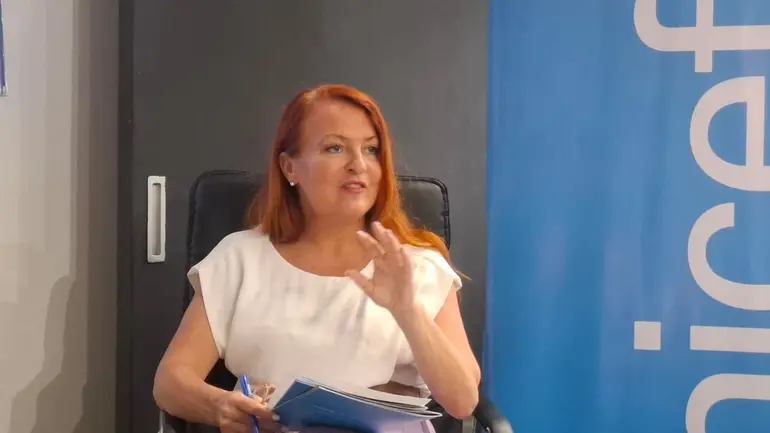
The United Nations Children’s Fund (UNICEF), Ghana, has commended the country for putting in place strong policies to support early childhood development but says more investment is needed to ensure that every child has an equal opportunity to thrive.
The commendation is contained in a new report titled ‘Unlocking Potential Early: Rebalancing Public Spending for Children in Ghana, 2026,’ which describes Ghana as being on the right path following the approval of its Early Childhood Care and Development (ECCD) Policy.
Speaking at a ceremony last Thursday, the Chief of Social Policy at UNICEF Ghana, Pauliina Sarvilahti, said although progress had been made, public spending on children remained low, delayed and unevenly distributed, particularly within the first five years of life.
She explained that this period was critical, as investments made during those years had the greatest impact on health, learning and future productivity.
Ms Sarvilahti indicated that children aged between zero and five years received only 13 per cent of total public spending on children, despite accounting for about one-third of the country’s child population.
She further noted that the report revealed disparities in resource allocation, with children from wealthier households benefiting from nearly twice as much public investment per person as those from the poorest households.
According to her, Ghana’s new ECCD Policy provided a solid foundation to address these challenges and could position the country as a leader in child-focused investment in Africa if effectively implemented.
Ms Sarvilahti explained that the study was the first age-based analysis of public spending on children in Ghana, covering the period from pregnancy to age 17. It also examined spending patterns across different income levels as well as rural and urban areas.
While acknowledging Ghana’s achievements in immunisation, reduction in under-five mortality and expansion of pre-primary education, she pointed out that gaps still existed in areas such as nutrition, birth registration, child grants and protection from violence.
She stated that government spending on children was heavily concentrated in education, which accounted for 3.1 per cent of Gross Domestic Product (GDP). In comparison, social protection received only 0.23 per cent of GDP, health about two per cent, and child protection just 0.3 per cent.
Ms Sarvilahti said the spending pattern reflected a broader trend across Africa, where governments tended to invest more in older children than in those in their early years.
She explained that, on average, African countries allocated only 6.5 per cent of child-related social spending to children aged zero to five, compared to 27 per cent in G20 countries, while about 55 per cent of spending in Africa went to children aged between 12 and 17 years.
For his part, the Lead Researcher and Managing Director of the Learning for Well-being Institute, Dominic Richardson, said a comprehensive package of child-focused investments, costing about 7.2 per cent of GDP, could eliminate child poverty within three years.
BY AGNES OPOKU SARPONG
Follow our WhatsApp Channel now! https://whatsapp.com/channel/0029VbAjG7g3gvWajUAEX12Q

