


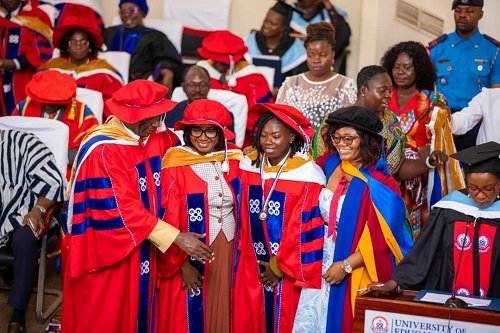
The Chancellor of the University of Education Winneba, Neenyi Ghartey VII, has challenged higher educational institutions to reorient their focus towards problem-solving and relevance by aligning teaching and research with the practical needs of society.
He stated that universities must align teaching, research, and community engagement with the real needs of society.
Neenyi Ghartey VII explained that graduates must be equipped not only with theoretical knowledge but also with practical skills that enable them to make meaningful impact.
He made the remarks at the 30th congregation of the university.
The four-day event saw a total of 7,951 students graduate from the College of Distance and e-Learning (CODeL) and the School of Graduate Studies, including 31 PhD graduates.
The Chancellor further noted that research should not be confined to academic journals but must inform policy, drive innovation, and create jobs.
He observed that opportunities were no longer guaranteed, and that individuals must increasingly create their own pathways.
Neenyi Ghartey VII therefore urged academic institutions to ensure efficiency, accountability, and relevance in their operations and programme design.
He stressed that the future of Ghana depended not only on policy frameworks but also on how institutions, leaders, and citizens respond to current challenges.
He also appealed to government not to treat universities as mere expenditure centres but as strategic partners in national development.
The Chancellor warned against underinvestment in education and research, describing knowledge as critical to long-term economic resilience.
In a speech read on his behalf, the Minister of Education, Haruna Iddrisu, indicated that the revised basic school curriculum, being developed by the National Council for Curriculum and Assessment, was nearing completion.
He explained that the revised framework would emphasise core academic competencies alongside social and emotional development, with the aim of producing well-rounded learners prepared for higher education and beyond.
The Minister noted that while early education remained a priority, secondary and tertiary education continued to play a central role in national development.
He added that government interventions, including expanded infrastructure and targeted support programmes such as free tertiary education for persons with disabilities, would be sustained.
Mr Iddrisu further indicated that the rapidly evolving global economy, driven by technology, required a rethink of the kind of graduates Ghana produces to remain competitive.
He stated that efforts were ongoing to integrate digital tools into teaching and learning, stressing that education must not remain detached from technological advancement.
In his address, the Vice-Chancellor of UEW, Prof. Stephen Jobsom Mitchual, reaffirmed the university’s commitment to improving infrastructure to support quality teaching and distance education.
He said the move would create a conducive academic environment, enhance access to education, and improve the welfare and security of both staff and students.
Prof. Mitchual noted that CODeL had expanded its postgraduate programmes with the introduction of new courses in early-grade education and social studies in response to national demand.
He also highlighted the growing number of female graduates, with 5,164 females compared to 2,787 males, describing it as a significant step towards gender inclusion and empowerment in higher education.
FROM DAVID O. YARBOI-TETTEH, WINNEBA
Follow our WhatsApp Channel now! https://whatsapp.com/channel/0029VbAjG7g3gvWajUAEX12Q

