


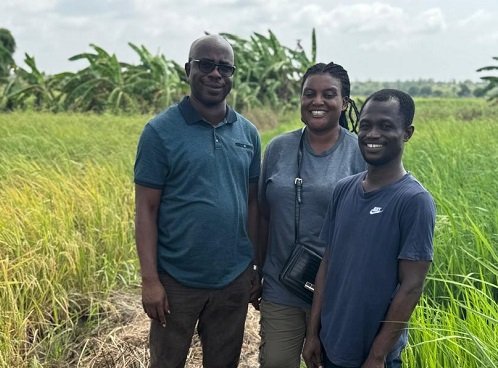
Rice farmers at the Weta Irrigation Scheme in the Volta Region are recording higher yields while using more than 30 per cent less irrigation water after adopting the Alternate Wetting and Drying (AWD) technology.
Researchers said the breakthrough could significantly strengthen Ghana’s efforts towards rice self-sufficiency by improving water-use efficiency without compromising productivity.
The findings, documented by a team of scientists including Dr Vincent Opoku Agyeman, Dr Stephen Yeboah, Dr Patricia-Amankwaah Yeboah, Dr Mavis Badu Brempong and Professor Ian C. Dodd, challenge the long-held belief that rice fields must remain continuously flooded throughout the growing season.
According to the researchers, rice can thrive under carefully managed wetting and drying cycles, provided appropriate varieties and sound water management practices are used.
A rice agronomist at the Council for Scientific and Industrial Research-Crops Research Institute (CSIR-CRI), Dr Stephen Yeboah, said years of research had shown that continuous flooding was not necessary for achieving high yields.
He explained that the AWD method allows farmers to cut irrigation water use by over 30 per cent while maintaining or even improving yields.
The research forms part of the African Agriculture Knowledge Transfer Partnership (AAKTP), a collaboration involving CSIR-Crops Research Institute, Lancaster University and New Age Agric Solutions.
It builds on earlier work under the UK-funded Recirculate Project supported by the Global Challenges Research Fund (GCRF).
The team evaluated 12 Ghanaian rice varieties under AWD conditions and found that CRI Agra and Ex-Baika consistently delivered the best performance, combining high yields with improved water-use efficiency.
To support adoption, the researchers introduced the Automated Water Table Alert (AWATA), a locally developed device that helps farmers determine the right time to irrigate, reducing water wastage and labour.
An AAKTP associate, Mr Vincent Opoku Agyeman, who coordinated field activities at Weta, said the main challenge was helping farmers transition from the long-standing practice of continuous flooding.
He said demonstration plots, hands-on training and ongoing technical support enabled farmers to observe the benefits of the technology under real farming conditions before adopting it.
Ten lead farmers were trained to monitor water levels using the AWATA device and adjust their practices to suit the alternating wetting and drying cycles.
Dr Patricia Amankwaah Yeboah said the results were visible and convincing, with farmers observing increased tillering, stronger panicles, healthier root systems and greener leaves.
According to the researchers, eight out of the 10 trained farmers have now adopted the AWD method on their farms, reporting higher yields while using less irrigation water.
Professor Ian C. Dodd of Lancaster University said the success of the project demonstrated how combining scientific research with simple decision-support tools could significantly improve water productivity.
The innovation has attracted the attention of the management of the Weta Irrigation Scheme.
The Scheme Manager, Mr Bernard Mawudzro, and the Scheme Agronomist, Mr Daniel Dompreh Amofah, described AWD as a practical solution capable of boosting rice production while conserving scarce water resources.
Following the positive results, management has expanded demonstration plots across the scheme to allow more farmers to learn and adopt the technology.
The researchers said the next phase of the project would explore the use of organic digestate to improve soil moisture retention, nutrient efficiency and yield stability under AWD conditions.
Dr Mavis Badu Brempong said integrating improved soil management with efficient irrigation could further strengthen productivity and enhance resilience to climate variability.
FROM KINGSLEY E. HOPE, KUMASI
Follow our WhatsApp Channel now! https://whatsapp.com/channel/0029VbAjG7g3gvWajUAEX12Q

