


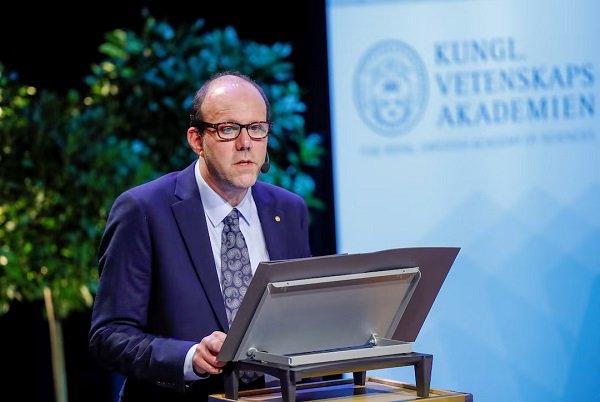
The World Bank on Wednesday named Nobel laureate and University of Chicago professor Michael Kremer as its next chief economist, succeeding Indermit Gill, who retired last month.
Kremer, 61, won the Nobel Prize in Economic Sciences in 2019 jointly with Esther Duflo and Abhijit Banerjee for their experimental approach to alleviating global poverty. He previously taught economics at Harvard University.
He starts his new role on October 1, shortly before the annual meetings of the World Bank and International Monetary Fund in Bangkok, Thailand.
Kremer is known for using rigorous research to develop innovative solutions to real-world problems, often setting up programs that have helped small farmers and given millions of people access to vaccines and school health programs.
“Michael has spent his career not just identifying what works in development, but proving it at scale and that is exactly the kind of thinking we need,” World Bank President Ajay Banga said in a statement.
“He joins us at a time when the world needs bold solutions to its most urgent development challenges, including creating jobs that meet the aspirations of more than 1.2 billion young people reaching working age in the coming decade.”
Kremer joins the bank as developing countries grapple with rising interest rates and higher energy prices in the wake of the U.S. war against Iran. Those challenges come on top of a 23 per cent drop in official development assistance in 2025, the sharpest on record, with the U.S. responsible for the lion’s share.
He is the first economist to come to the bank with a Nobel in hand. Others, including Joseph Stiglitz and Paul Romer, received the honor after their tenure as chief economist.
Kremer currently serves the director of the Development Innovation Lab at the University of Chicago, where his research has been focused on innovation in education, health, water, finance, and agriculture in developing countries.
“The World Bank Group has tremendous research capacity to develop and test innovative solutions to development problems and the operational reach to scale them up and improve people’s lives,” Kremer said in a statement.
The world faced enormous challenges, but new technologies offered opportunities to boost growth, he said.
In the early 2000s, he also proposed a framework aimed at preventing dictators from looting their countries and saddling future citizens with illegitimate or “odious” debt. – Reuters
You can now read the *Ghanaian Times* and *The Spectator* newspapers digitally on [TimesNewsPlus](https://timesnewsplus.com/newspapers).
Follow our WhatsApp Channel now! https://whatsapp.com/channel/0029VbAjG7g3gvWajUAEX12Q

