An $8.39 million education project jointly implemented by the Governments of Ghana and the Republic of Korea has delivered life-changing impact to more than 49,000 students across the Eastern and Central Regions.
The five-year initiative, known as the STEM Phase I Project, focused on enhancing girls’ competence in mathematics and science through gender-responsive and inclusive teaching methods in junior high schools.
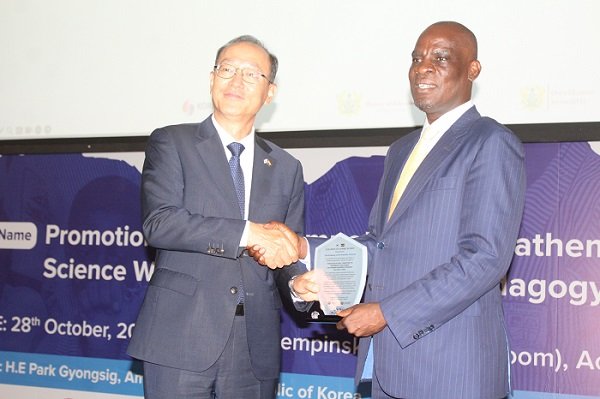
The project, funded by the Korea International Cooperation Agency (KOICA) in partnership with Ghana’s Ministry of Education and the Ghana Education Service, officially came to a close at a ceremony held at the Kempinski Hotel in Accra yesterday.
Speaking at the ceremony, the Minister for Education, Mr. Haruna Iddrisu, expressed profound appreciation to the Government of Korea and KOICA for their continued investment in Ghana’s education sector.

He said the emphasis on science and mathematics was crucial to preparing young Ghanaians for a rapidly changing world.
“If we are to succeed in developing critical minds and analytical skills to drive technological advancement, we must continue to strengthen mathematics and science education,” he said.
“The roots of artificial intelligence and modern innovation lie in these fields, and we are grateful to the Korean government for supporting Ghana’s efforts in this direction.”
Mr. Iddrisu also announced plans to expand science education infrastructure by establishing a science resource centre in Tamale to serve schools in the northern part of the country.
He praised teachers for embracing innovative approaches and urged greater participation of girls in Science, Technology, Engineering, and Mathematics (STEM) fields.
“We must find out what discourages many girls from taking up these subjects and work together to change that. The future belongs to those who embrace technology and innovation, and we cannot afford to leave our girls behind,” he said.
The Korean Ambassador to Ghana, Gyongsig Park, commended the collaboration between the two countries and highlighted the impressive results of the first phase of the project.
He announced that, encouraged by its success, the Government of Korea would launch a new phase — the STEM Phase II Project — beginning next year and running until 2032.
“The next phase will expand to the Ashanti Region, covering around 800 schools and 1,600 teachers nationwide. It will also introduce digital learning in mathematics and science through tablets and smart classrooms — helping students learn in ways that reflect the future we are building,” he explained.
He further revealed that KOICA would support the establishment of a state-of-the-art ASPIRE Centre, a national hub for digital learning, innovation, and teacher training — as a lasting symbol of Korea-Ghana friendship and their shared commitment to inclusive and forward-looking education.
The Director-General of the Ghana Education Service, Professor Ernest Kofi Davis, praised the project for significantly improving teaching quality and student performance.
He said the Teacher Learning Circles (TLCs) had strengthened collaboration among educators and inspired a new sense of purpose in the classroom.
Launched in 2021, the project supported 400 junior high schools in 10 districts, training over 800 mathematics and science teachers, 400 head teachers, and 68 School Improvement Support Officers.
It introduced innovative methods such as the Teacher Learning Circles (TLCs), which created collaborative platforms for teachers to share experiences, learn new skills, and strengthen their teaching practices. This approach helped improve teacher confidence and student learning outcomes, particularly among girls.
BY AGNES OPOKU SARPONG
🔗 Follow Ghanaian Times WhatsApp Channel today. https://whatsapp.com/channel/0029VbAjG7g3gvWajUAEX12Q
🌍 Trusted News. Real Stories. Anytime, Anywhere.
✅ Join our WhatsApp Channel now! https://whatsapp.com/channel/0029VbAjG7g3gvWajUAEX12Q