A 24-year-old Ghanaian Researcher in the US makes groundbreaking CO₂ storage discovery, rises to Top 8 Worldwide in the Elite Society of Petroleum Engineers Global Competition
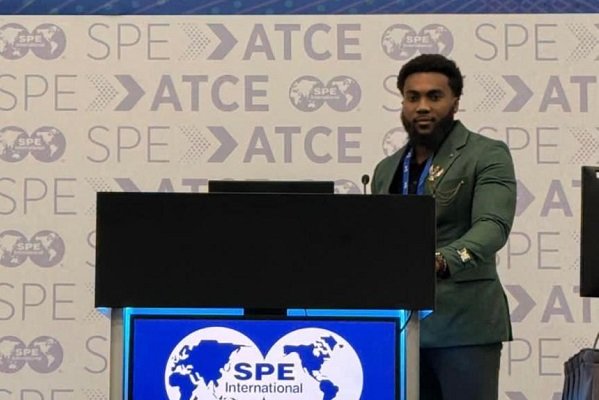
IN a landmark scientific advance with far-reaching implications for global decarbonisation, Ghanaian researcher, Prince Henry Sampson Eduam, a PhD candidate at The Ohio State University (OSU), has delivered one of the strongest experimental confirmations yet that the Marcellus Shale—a vast unconventional reservouir system spanning the Appalachian Basin—can securely retain injected carbon dioxide (CO₂) over geological timescales.
His research, presented at the Society of Petroleum Engineers (SPE) Annual Technical Conference, directly challenges long-standing doubts about shale formations as viable carbon sinks. Rather than allowing CO₂ to escape, his laboratory work demonstrates that the gas becomes adsorbed, immobilised, and structurally confined within the rock matrix, offering a scientifically grounded pathway for large-scale geological carbon storage in one of North America’s most extensive formations.
This finding is transformative: the Marcellus region already contains decades of infrastructure from natural gas development. Showing that it can transition from hydrocarbon production to secure CO₂ storage presents a dual opportunity—retiring old assets while advancing climate solutions at continental scale.
To resolve the uncertainty surrounding shale-based carbon sequestration, Prince Henry designed a multi-modal experimental framework spanning molecular interactions to core-scale flow. Collectively, these experiments generate some of the most convincing modern laboratory evidence that shale not only stores CO₂ but gradually increases its trapping efficiency.

Using pulse-decay permeability testing, he quantified how helium, methane, and CO₂ migrate through shale under reservouir conditions. CO₂ injection produced a distinctive two-phase decline in permeability, a signature of sorption-driven retention and subsequent chemo-mechanical modification of the rock.
Surface-area and pore-structure analyses (BET/BJH) confirmed that Marcellus Shale contains an exceptionally dense distribution of nanopores that preferentially attract and hold CO₂. This mechanism explains the initial rapid permeability drop—an immediate adsorption event in which CO₂ firmly binds to internal pore surfaces.
However, adsorption alone did not account for the dramatic reduction in flow capacity. Raman spectroscopy revealed that CO₂ interacts chemically with kerogen, producing slight swelling and rearrangement in the organic matrix. These subtle structural shifts constrict pore throats and reduce fracture connectivity, giving rise to the second permeability decline, driven by chemo-mechanical locking. This means the rock physically adjusts to confine CO₂ more effectively.
The implications are significant: with its massive scale, existing infrastructure, and inherent sorptive capacity, the Marcellus could become a central pillar of North America’s long-term carbon storage strategy.
This groundbreaking work propelled Prince Henry into the highest levels of global recognition within the petroleum engineering community. His paper, “Sorption-Induced Permeability Evolution and Chemo-Mechanical Interactions of CO₂ Sequestration in the Marcellus Shale,” became the basis for his entry into the prestigious SPE Student Paper Competition, widely regarded as the most selective contest in petroleum engineering.
His rise through the competition was exceptional. Prince Henry won the Eastern North America and Mid-Continent Regional Championship, claiming the sole PhD finalist position for the entire region. This victory earned him a place in the SPE International Finals, where only eight researchers worldwide competed. Reaching this tier is a distinction reserved for only the most accomplished early-career scientists.
Standing among the global top eight signifies extraordinary scientific merit, competitive excellence, and recognition by the world’s premier petroleum engineering society. Judges praised his study as “methodologically rigorous,” “scientifically exceptional,” and “a contribution that advances subsurface carbon storage science.” His integration of petrophysical measurements with molecular-scale spectroscopy provided a new mechanistic understanding of CO₂–shale interactions—setting him apart as a rising leader in carbon sequestration research.
Prince Henry’s achievement marks an important milestone not only for his personal career but also for Ghana’s scientific presence on the world stage. His success highlights the country’s growing contributions to unconventional reservouir science and climate-related innovation.
Reflecting on this accomplishment, he noted, “Although I competed as a researcher based in the United States, I stand on the discipline and values shaped in Ghana. This recognition honours both OSU’s support and the expanding scientific potential of Ghanaian scholars committed to global environmental progress.”
His accomplishment serves as a powerful message to the next generation: world-class excellence is attainable, irrespective of geographic origin. Through his pioneering work, Prince Henry stands among the emerging scientific voices helping to shape the global energy transition and advance the field of CO₂ geo-sequestration.
🔗 Follow Ghanaian Times WhatsApp Channel today. https://whatsapp.com/channel/0029VbAjG7g3gvWajUAEX12Q
🌍 Trusted News. Real Stories. Anytime, Anywhere.
✅ Join our WhatsApp Channel now! https://whatsapp.com/channel/0029VbAjG7g3gvWajUAEX12Q