The Constitutional Review Committee has dismissed any possibility of a third presidential term in Ghana’s democratic architecture.
According to the Committee, provisions of Article 66(2) of the 1992 Constitution are clear and without ambiguity; hence needed no tweaking when the country goes to the polls for a referendum to amend the constitution.
The Article states that “A person shall not be elected to hold office as President of Ghana for more than two terms”.
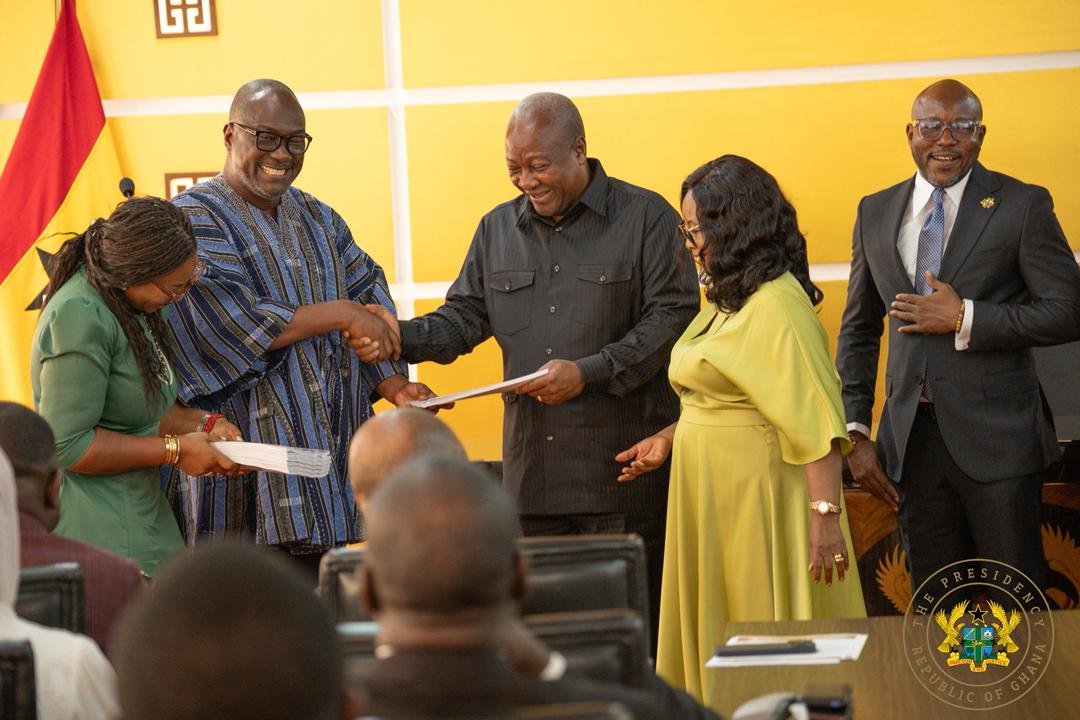
Presenting the summary of the report to the President at the Presidency in Accra yesterday, Chairman of the Committee, Professor H. Kwesi Prempeh said Ghanaians are not even interested in a third term for the president.


“Mr President, we couldn’t find a place for a third term. We looked and looked and looked but still couldn’t find,” he said to loud laughs from the President, government officials and members of the Committee assembled for the presentation.
“There wasn’t much of a demand for it. The only thing was for us to clarify ambiguity in 66(2) but we didn’t want to go there because we didn’t think that it raises any issues of ambiguity,” he said.
However, Professor Prempeh said: “many of the eminent persons we met including some who have occupied [the seat of the president]” think that the four year tern was too short.
He said the emerging global norm was five year term.
“So we are proposing an additional one year [to make it five year term].”
To sanitise the electioneering campaign space, Professor Prempeh said the Committee was proposing a “short campaign season” so that persons mandated with the task of governing would have the time to do so.
The Committee, Prof. Prempeh said, was also proposing that the current hybrid governance system where members of Parliament also serve as ministers be dispensed with.
“The current system is not working,” he said. “We are proposing that we separate executive from Legislature to allow parliament focus on its mandate of oversight over the executive.”
On local governance, he said Ghanaians were of the weakening view that metropolitan, municipal and district chief executives be elected.
That, however, he said would not be blanket as the election would be based on specific benchmark which must be met by a particular assembly to have their chief executive elected.
Prof. Prempeh hinted at an Ethics and Anti-Corruption Commission to harmonise the prosecution of corruption cases adding that the responsibility of appointment to some offices would be shouldered by the Council of State.
He described their recommendations as actionable, having spoken to a broad-base of Ghanaians including academia to trade union with the hope that their work would be accepted by Ghanaians.
Receiving the report, President Mahama said government would be zooming into the implementation of the recommendations early next year.
“For now we’ll study the report and hand it over to the legal counsel and the Attorney-General to look at it and we’ll see how to synchronise our views. I think that many of the recommendations you’ve made are quite revolutionary. Some are quite radical, but I think that it’s in the interest of our democracy,” the President said.
He said the 1992 constitution, the most durable in Ghana’s history, has served the country very well but the time had come to look at it and make some adjustments so that it could serve for longer period going into the future.
BY JULIUS YAO PETETSI
🔗 Follow Ghanaian Times WhatsApp Channel today. https://whatsapp.com/channel/0029VbAjG7g3gvWajUAEX12Q
🌍 Trusted News. Real Stories. Anytime, Anywhere.
✅ Join our WhatsApp Channel now! https://whatsapp.com/channel/0029VbAjG7g3gvWajUAEX12Q