The construction industry inflation rate fell sharply to 4.4 per cent in December 2025, compared with 22.6 per cent in December 2024, the Ghana Statistical Service (GSS) has announced.
The December 2025 building inflation rate represents an 18.2 percentage point decline relative to the 22.6 per cent recorded during the same period last year.
On a month-on-month basis, inflation for the construction sector decreased by 0.2 per cent between November and December 2025.
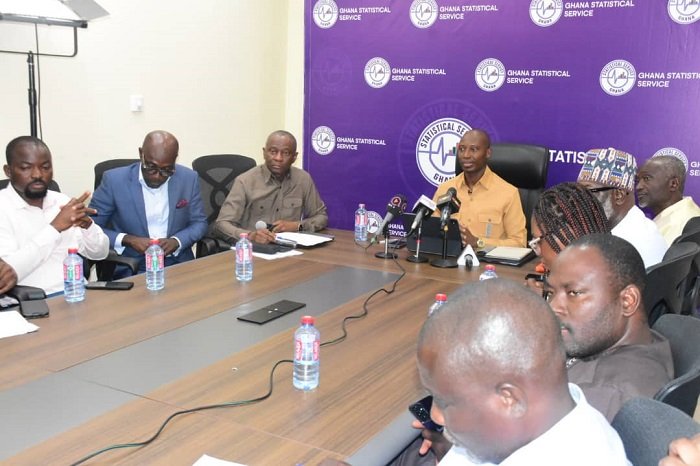
Speaking at a news conference in Accra yesterday to release the Ghana December 2025 Prime Building Cost Index and Inflation, the Government Statistician, Dr Alhasan Iddrisu, said the construction sector experienced strong price stability throughout 2025.


He said the December building inflation rate marked the eighth consecutive decline in year-on-year building inflation.
According to him, the December figure also represented a 1.5 percentage point drop from the November 2025 inflation rate of 5.9 per cent and an 18.2 percentage point decline from the December 2024 rate of 22.6 per cent.
Dr Iddrisu explained that the Prime Building Cost Index for December 2025 stood at 131.0, up from 125.5 in December 2024, translating into a year-on-year inflation rate of 4.4 per cent for the building industry.
He said labour remained a major influence on the building inflation rate in December 2025.
Breaking down the inflation into its major components, Dr Iddrisu said labour inflation declined to 10.7 per cent in December 2025 from 12.7 per cent in November 2025 and 21.3 per cent in December 2024.
On a month-on-month basis, labour costs fell by 0.9 per cent, although year-on-year labour inflation remained higher than the overall industry rate.
He said materials inflation also eased further, falling to 2.7 per cent year-on-year in December 2025, compared with 4.2 per cent in November and 23.5 per cent a year earlier.
“Material prices declined marginally by 0.1 per cent month-on-month, suggesting improved stability in material costs for builders and contractors,” Dr Iddrisu stated.
However, the Government Statistician noted that plant and equipment inflation rose to 5.6 per cent year-on-year in December 2025, up from 5.3 per cent in November, while month-on-month inflation increased by 1.5 per cent.
He said this posed challenges for contractors engaged in machinery-intensive projects such as roadworks and large-scale infrastructure development.
At the subgroup level, equipment recorded the highest inflation at 14.9 per cent, while reinforcement registered the lowest inflation at negative 7.3 per cent, indicating a decline in prices.
Dr Iddrisu further indicated that items such as cement, roofing sheets and small tools recorded reductions in inflation, helping to pull overall building inflation down.
He added that steel, skilled labour, unskilled labour, towels and equipment together contributed nearly all of the overall building inflation, underscoring the need for targeted policy interventions.
Dr Iddrisu advised government to take advantage of the easing building inflation to fast-track key infrastructure projects, while encouraging businesses to secure medium-term contracts.
He also urged households to consider resuming building projects as material prices continued to stabilise.
By Kingsley Asare
Follow Ghanaian Times WhatsApp Channel today. https://whatsapp.com/channel/0029VbAjG7g3gvWajUAEX12Q
Trusted News. Real Stories. Anytime, Anywhere.
Join our WhatsApp Channel now! https://whatsapp.com/channel/0029VbAjG7g3gvWajUAEX12Q