EC lays EV charging regulations before Parliament
The Energy Commission (EC) has laid the Electric Vehicle Charging Station and Battery Swap Systems Regulations, 2026 before Parliament to establish a regulatory framework for the safe and orderly development of electric vehicle (EV) charging and battery-swap systems in the country.
The Executive Secretary of the EC, Ms Adwoa Serwaa Bondzie, said the regulations, which are expected to complete the constitutional process in October this year, would provide a comprehensive framework covering safety standards, licensing and registration requirements for the expansion of electric mobility in Ghana.
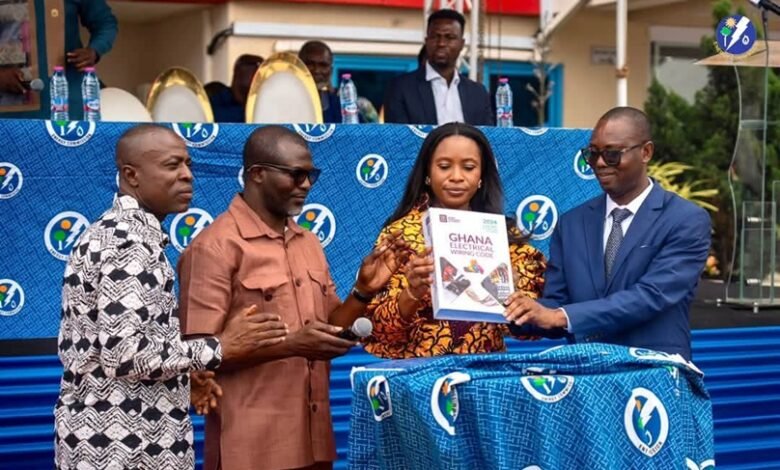
She was speaking at the 25th edition of the Electrical Wiring Certification and Awards ceremony in Accra on Tuesday, where a new Electrical Wiring Code was also launched to improve safety and facilitate the integration of modern energy technologies.
The ceremony, on the theme: ‘Setting the Standard: Powering Ghana’s Future, EV, Solar, and Beyond,’ saw 884 electrical professionals graduate after sitting the May/June 2026 examination.


Ms Bondzie said the growing deployment of EV charging stations could not be treated as isolated electrical installations because they formed part of the wider electricity and digital ecosystem and had implications for the capacity and reliability of the national power grid.
“As electric mobility grows, our regulatory framework must grow with it. The objective of the Commission is not to restrain innovation but to ensure that innovation develops a sound foundation,” she said.
She disclosed that the EC, in collaboration with the Ministry of Energy and Green Transition, was also developing a national EV charging system management platform to provide visibility over charging infrastructure across the country.
The platform, she said, would enable the Commission to monitor charging stations, energy consumption, faults, outages and geographical coverage, while generating data to assess the impact of EV charging on the electricity network.
Touching on the new wiring code, Ms Bondzie said electricians were increasingly required to work with solar photovoltaic (PV) systems, battery storage, inverters and EV charging infrastructure, making it necessary for national standards to evolve alongside technology.
The new code, developed in collaboration with the Ghana Standards Authority (GSA), would provide standards for the next phase of Ghana’s electrical and energy transition, she said.
She also assured that the EC would work closely with the Commission for Technical and Vocational Education and Training (CTVET) to review the electrical wiring training syllabus to align it with the new code.
“There must be a clear connection between what we regulate, what we teach, what we assess and what we certify,” she said.
Ms Bondzie urged the newly certified electricians to commit themselves to continuous learning, professional integrity and safety as the energy sector evolved.
The Acting Executive Secretary further assured that the EC would continue to strengthen apprentice registration and structured training, promote continuous professional development, enforce regulations and technical standards, and deploy digital tools to improve regulatory efficiency and transparency.
“As technology changes, we too must change but the principles of safety, competence, integrity and accountability must remain constant,” she said.
The Deputy Director-General in charge of Operations at the GSA, Dr Awal Mohammed, said the authority was committed to increasing surveillance and enforcement to ensure the safety of electrical products on the Ghanaian market.
BY ABIGAIL ANNOHYou can now read the *Ghanaian Times* and *The Spectator* newspapers digitally on [TimesNewsPlus](https://timesnewsplus.com/newspapers).
Follow our WhatsApp Channel now! https://whatsapp.com/channel/0029VbAjG7g3gvWajUAEX12Q