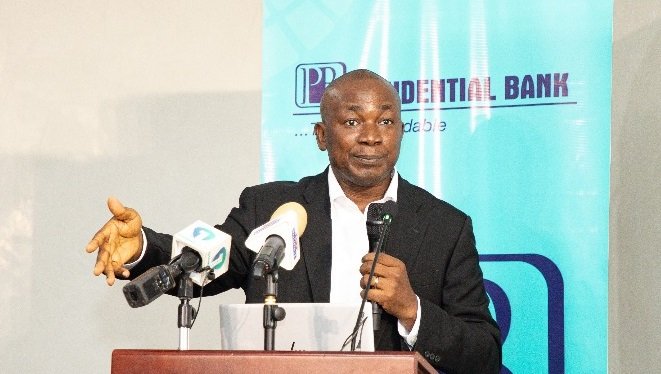
Economist and Finance Lecturer at the University of Ghana Business School, Professor Godfred A. Bokpin, has urged the government to build stronger reserves to sustain the stability of the Ghana Cedi.
He noted that while the recent appreciation of the currency was commendable, it was not sustainable without deliberate efforts to strengthen foreign reserves, attract the right capital, and grow domestic savings.
Prof. Bokpin made the call at a special customer seminar organised by Prudential Bank in Accra on Thursday on the theme: “The Ghana Cedi Appreciation in 2025 – Outlook and Impact on Business.”
He said the government’s expenditure discipline in the first half of the year was laudable, but stressed the need for consistency to rebuild investor confidence and avoid dislocations in the economy.

“We are not saving, we are not accumulating capital, and therefore we rely heavily on foreign direct investment and portfolio flows. But we must manage this well, target the right sectors, and insist on joint ventures to transfer skills and technology to local businesses,” he said.
According to him, the intended benefits of foreign direct investment (FDI) had not fully materialised in terms of job creation, despite generous tax concessions.
“Between 2012 and 2023, FDI contributed to only about 250,000 jobs, while over 2.7 million people entered the labour market,” he noted.
Prof. Bokpin also cautioned against excessive concessions to foreign investors at the expense of small and medium enterprises (SMEs).
“Our SMEs are largely low-tech. We must create the right environment for them to partner with foreign businesses and benefit from advanced technology, just like China did,” he added.
The Economist said the banking sector’s high interest rate regime remained unfavourable for SMEs and called for deliberate policies to grow indigenous private capital.
On infrastructure, he urged government to leverage public-private partnerships rather than putting major projects such as roads and railways solely on the state’s balance sheet.
The Chief Executive Officer of the Association of Ghana Industries (AGI), Mr Seth Twum-Akwaboah, said the Cedi’s unusual stability had brought relief to manufacturers by lowering import costs, improving margins, and boosting confidence.
“For years, Cedi volatility distorted business decisions. Today, the stronger Cedi has reduced the cost of importing machinery, spare parts and raw materials, and improved the business confidence index,” he said.
He explained that the appreciation had also reduced debt levels and fuel costs, with positive effects on inflation and consumer purchasing power.
However, he cautioned that the stronger Cedi was hurting export competitiveness and encouraging cheaper imports, which threatened local manufacturers.
“One of our member companies that exports to the sub-region has warned it may shut down if the situation persists. Their production costs have not gone down, yet they earn fewer Cedis when they repatriate export proceeds,” he said.
The Managing Director of Prudential Bank, Mr Bernard Gyebi, said the seminar was part of the bank’s commitment to help businesses navigate the changing economic landscape.
“The appreciation of the Ghana Cedi presents both opportunities and challenges. At Prudential Bank, we are committed to supporting our customers with innovative solutions, including trade finance and foreign exchange services, to help them adapt,” he said.
Mr Gyebi said the bank would continue to provide platforms for dialogue and networking to enable businesses to share experiences and strategies in coping with the new environment.
BY KINGSLEY ASARE
🔗 Follow Ghanaian Times WhatsApp Channel today. https://whatsapp.com/channel/0029VbAjG7g3gvWajUAEX12Q
🌍 Trusted News. Real Stories. Anytime, Anywhere.
✅ Join our WhatsApp Channel now! https://whatsapp.com/channel/0029VbAjG7g3gvWajUAEX12Q