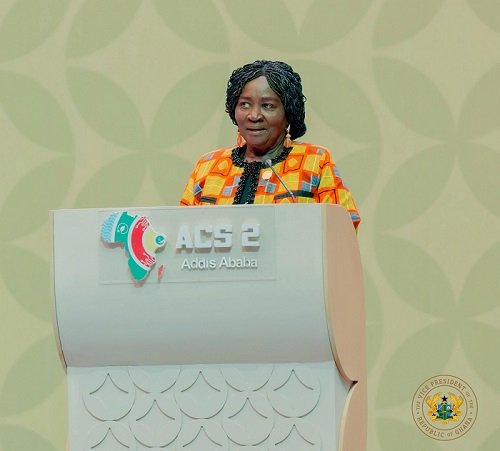
The Vice President of Ghana, Professor Naana Jane Opoku-Agyemang, has reaffirmed Ghana’s strong commitment to fighting climate change and advancing sustainable development on the continent.
Speaking at the 2nd Africa Climate Summit in Addis Ababa, she stressed that Africa must see climate action not only as a necessity but also as a chance to build resilience and prosperity for its people.
In her address, the Vice President highlighted Ghana’s role as host of the Climate Vulnerable Forum and the Vulnerable 20 Group, pointing out that this responsibility comes with the duty to lead by example.
She explained that climate change continued to pose serious risks to Africa’s development, but at the same time, presented new opportunities for growth if the right measures were taken.


“Our focus must be on turning climate risks into opportunities through innovation, green growth, and sustainable practices,” she said.
Prof. Opoku-Agyemang said Africa could not rely only on technology developed elsewhere, saying “Instead, the continent must work to become a leader and contributor to global climate solutions.”
According to her, that required governments, businesses, and communities to invest in new approaches that not only protect the environment “but also create jobs and support inclusive growth.”
The Vice President urged African leaders to pay more attention to nature-based solutions, saying “these hold enormous potential for addressing environmental challenges while improving livelihoods.”
She praised Ethiopia’s 40 billion trees project as a practical example of how ambitious local action could make a major difference.
Such a project, she said, showed the transformative power of working with nature and demonstrated that African countries could chart their own paths in climate leadership.
Professor Opoku-Agyemang also stressed the importance of regional cooperation and noted that climate change did not respect national borders, and therefore solutions must be built on partnerships, collaboration, and shared responsibility.
“Climate policies must be grounded in regional cooperation and a strong sense of collective ownership across the continent,” she said.
In her view, African countries would be stronger and more effective if they work together and pool resources in order to achieve their climate goals.
She further emphasised that the continent’s climate agenda must go beyond reducing vulnerabilities, but should be to empower African communities to thrive sustainably.
“This means building systems and structures that support long-term resilience, such as investing in renewable energy, sustainable agriculture, and green infrastructure,” the Vice President stated.
By doing so, she said Africa would not only protect its environment but also create opportunities for young people, women, and other vulnerable groups to take part in and benefit from the transition.
According to her, climate change was one of the biggest challenges of the present generation, but also offered Africa the opportunity to redefine its development path.
“Instead of following the traditional routes that often harm the environment, the continent can leap forward by adopting green practices that balance growth with sustainability,” she explained.
The Africa Climate Summit brought together leaders, policymakers, and stakeholders from across the continent to deliberate on strategies to address the worsening effects of climate change.
It served as a platform for countries to share experiences, build alliances, and commit to stronger action in the face of the climate crisis.
BY AGNES OPOKU SARPONG
🔗 Follow Ghanaian Times WhatsApp Channel today. https://whatsapp.com/channel/0029VbAjG7g3gvWajUAEX12Q
🌍 Trusted News. Real Stories. Anytime, Anywhere.
✅ Join our WhatsApp Channel now! https://whatsapp.com/channel/0029VbAjG7g3gvWajUAEX12Q