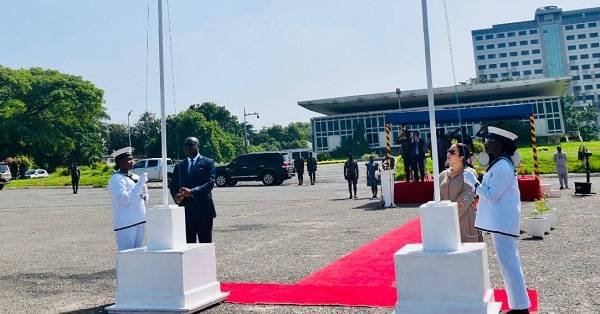
Ghana on Friday joined the rest of the continent to commemorate the 61st African Union (AU) Day with a flag-raising ceremony at the forecourt of the State House in Accra.
The actual day was Saturday, a weekend.
The AU, originally the Organisation of African Unity (OAU), was formed on May 25, 1963, to ensure the complete political emancipation of the African people through the promotion of unity and solidarity.
In 2002, the OAU was transformed into its current state and named with the vision to foster solidarity and harness the resources and resourcefulness of Africans for sustained economic emancipation.


The day is celebrated annually to honour the efforts of the founding fathers who embraced the vision of a united Africa and fought for the liberation of the continent.
This year’s celebration was marked on the theme: ‘Education Fit for the 21st Century: Building Resilient Education Systems for Increased Access to Inclusive, Lifelong Quality and Relevant Learning in Africa.’
It was attended by members of the diplomatic community, especially the African group; security services who constituted the parade contingent, and school children.
The Deputy Minister of Foreign Affairs and Regional Integration, Kwaku Ampratwum-Sarpong, reaffirmed the government’s commitment to continued investment in education to empower every Ghanaian to meet the country’s human resource needs.
He said this year’s theme underscored the crucial role of education in the continent’s development, for which reason the government introduced the Free Senior High School Policy to significantly improve education access and gender parity in Ghana.
The focus, he said, was on creating resilient, inclusive education systems tailored to the 21st century, thereby achieving the UN Sustainable Development Goal 4 and preparing citizens for a skills revolution driven by science, technology, and innovation, as envisioned in Agenda 2063.
The Deputy Minister said the AU’s current focus on socio-economic emancipation underscored its commitment to addressing critical issues such as food security, energy crises, democracy, climate change, health challenges, internal conflicts, terrorism, and violent extremism.
The Secretary-General of the African Continental Free Trade Area (AfCFTA), Wamkele Mene, in a speech read on his behalf, called on the private sector to seize the opportunities presented by the AfCFTA, as it offered a single investment area and a predictable legal and regulatory framework for trade and investment across the continent.
BY JONATHAN DONKOR & STEPHANIE BIRIKORANG