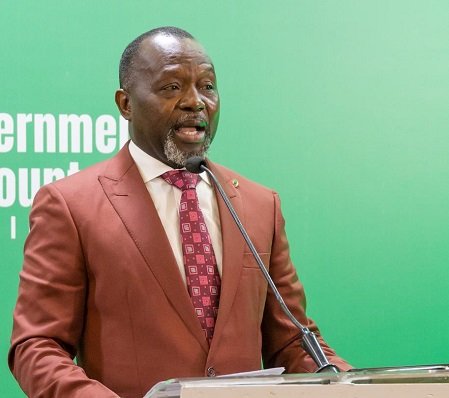
The government has accepted the recommendation of the Constitutional Review Committee (CRC) to extend the term of office of the President from four to five years, with the tenure of Parliament adjusted accordingly.
The Attorney-General and Minister for Justice, Dr Dominic Akurutinga Ayine, said the move was aimed at providing administrations with more time to plan, implement and assess policies.
“Under the current four-year cycle, the early months of every administration are consumed by transition, and the final year is lost to elections. A five-year term provides a more realistic timeframe for policy formulation, implementation and assessment,” he explained.
Dr Ayine made this known at the Presidency in Accra yesterday when he presented the government’s position paper on the recommendations of the CRC.


He said, subject to approval through a referendum, the government also supported a fixed single, non-renewable 10-year term for the Chief Justice, up to the mandatory retirement age of 70 years.
He added that the government had proposed capping the number of Supreme Court justices at 19, comprising the Chief Justice and 18 other justices.
“The Committee recommended a cap of 15 justices; government proposes 19 justices; Chief Justice plus 18 Justices of the Supreme Court. This promotes efficiency, manages public expenditure, while remaining sufficiently robust to discharge the Court’s constitutional mandate,” he said.
Dr Ayine, who is also the Member of Parliament for Bolgatanga East, said Ghanaians were expected to vote in a referendum next year on the proposed amendments to the 1992 Constitution.
The referendum, he explained, would be held alongside the District Assembly elections to allow citizens to endorse or reject the government’s position on the recommendations of the Prof. Henry Kwesi Prempeh-led committee.
The CRC report, titled “Transforming from Electoral Democracy to a Developmental Democracy,” was presented to President John Dramani Mahama in February 2026, after which three Cabinet retreats were held before government arrived at its position.
Among the other recommendations considered were presidential election dates, election petitions, presidential taxation, the minimum age for presidential candidates, the size of government and Parliament.
On the minimum age for the Presidency, Dr Ayine said although the committee recommended 30 years, the government’s position was that it should be raised to 35 years.
“Thirty-five is consistent with modern democratic constitutions towards greater inclusivity of youth, whilst ensuring candidates have maturity and experience,” he said.
He said government had also accepted the proposal for presidential elections to be held in the first week of November, arguing that a fixed date would provide certainty in the electoral calendar and allow sufficient time between elections and the January 7 inauguration.
Dr Ayine said government supported a constitutional requirement for presidential election petitions to be filed within 14 days after the declaration of results and determined by the Supreme Court within 30 days.
He added that the Electoral Commission would be required to provide relevant electoral data to the court and all parties involved in the hearing.
On presidential taxation, the Attorney-General said government had accepted in principle that the President should pay taxes on salary, allowances and applicable direct taxes on bills and services. However, taxes on presidential retirement gratuity and pension would remain exempt.
On the size of government, Dr Ayine said while the CRC recommended a maximum of 57 ministers, government proposed an upper limit of 60.
He added that ministers could either be appointed from Parliament or outside it.
Regarding Parliament, he said the legislature would be capped at 300 members, with an additional 24 seats created through proportional representation for women, persons with disabilities and the youth.
Dr Ayine further disclosed that dual citizens by birth would no longer be barred from contesting parliamentary elections solely because of their dual citizenship.
“Multiple citizenship will no longer disqualify a person from holding specified offices, except that of President and Vice President,” he stated.
He also announced that District Chief Executives would be elected, with the President nominating five persons including two women from whom three candidates would be shortlisted for election.
BY JULIUS YAO PETETSI
Follow our WhatsApp Channel now! https://whatsapp.com/channel/0029VbAjG7g3gvWajUAEX12Q