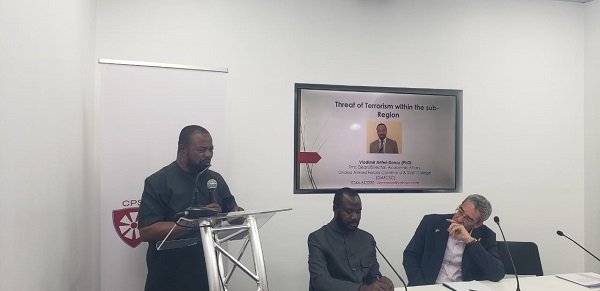
Ghana must urgently adopt a more coordinated and intelligence-driven security approach to confront the rising threat of terrorism spreading across West Africa, international relations and security expert, Dr Vladimir Antwi-Danso, has cautioned. He noted that the country’s current fragmented approach to intelligence management had gaps, stressing that Ghana could not afford complacency as extremist groups pushed further south from the Sahel and sought new operational spaces within coastal states.
“If Ghana is to survive the coming wave, intelligence systems must be better coordinated, communities must be sensitised, and borders must be more effectively monitored,” he emphasised. Dr Antwi-Danso made the call at a high-level conference organised by the Centre for Policy Scrutiny (CPS) in Accra on Tuesday, under the theme: ‘Fighting Terrorism in the Middle East and Africa.’ The event was attended by security analysts, diplomats, legislators, and members of civil society groups.
Dr Antwi-Danso explained that West Africa is not only the epicentre of global extremist activity but also highly lethal, with insurgent groups expanding their reach, adapting swiftly to counter-operations, and exploiting vulnerabilities within states. He noted that terrorism today has evolved beyond conventional violence, adding that “Terrorism is no longer just about guns and bombs. It is ideological, economic, and social.”
He further highlighted that insurgent organisations operating in the Sahel now rely on sophisticated, decentralised networks that allow them to operate discreetly across vast terrains. The splintering of groups such as ISIS and Al-Qaeda has produced smaller but highly mobile cells, making detection and containment more complex.


Citing a 2024 United Nations assessment, Dr Antwi-Danso said 56 per cent of global terrorism occurs in the Sahel, with West Africa accounting for 70 per cent of all recorded attacks between 2016 and 2024. This firmly positions the sub-region as the world’s deadliest hotspot for extremist violence.
He traced the roots of Sahel instability to long-standing governance gaps and unresolved historical tensions, emphasising that “The collapse of Libya in 2011 sharply exacerbated insecurity as heavily armed fighters dispersed into neighbouring countries, fuelling insurgencies that continue to spread southwards.” He stressed that lack of access to jobs, education, and essential services makes extremist narratives appealing, and argued that military force alone cannot counter the ideology underpinning violent extremism.
The Israeli Ambassador to Ghana, Liberia, and Sierra Leone, Mr Roey Gilad, added that tackling terrorism requires addressing money laundering, cutting the supply of weapons, and enforcing United Nations Security Council Resolution 1701 to isolate terror internationally. He highlighted Israel’s extensive counterterrorism experience and stressed the importance of closer cooperation with Ghana.
BY CLIFF EKUFUL
🔗 Follow Ghanaian Times WhatsApp Channel today. https://whatsapp.com/channel/0029VbAjG7g3gvWajUAEX12Q
🌍 Trusted News. Real Stories. Anytime, Anywhere.
✅ Join our WhatsApp Channel now! https://whatsapp.com/channel/0029VbAjG7g3gvWajUAEX12Q