International community must help African governments fight organised crimes
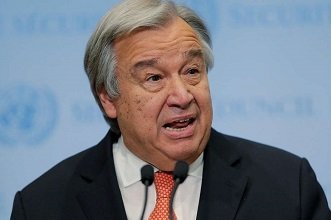
The Secretary-General of the United Nations (UN), António Guterres, has urged the international community to support efforts by African governments to fight tax evasion, money laundering and illicit capital flows.
Addressing the African Union (AU) Summit in Addis Ababa, yesterday, he said the community should show stronger determination because these issues were depriving African countries of essential resources for development.
“I have been witnessing the efforts of many governments in Africa to eliminate corruption, reform tax systems and improve governance and institutions.
“But the international community must complement these efforts with much stronger determination in fighting tax evasion, money laundering and illicit flows of capital,” he said.

According to Mr Guterres, although there had been significant improvements in living standards on the continent, including access to quality education, health care, food security, basic social services and infrastructure, “progress remains slow and uneven when it comes to eradicating poverty and ending exclusion.”
He said Africa had been a victim of a globalisation, given that it had not “benefitted all nations equitably, with agricultural and other subsidies, trade and financial rules and distorted markets working often to the detriment of the continent.
“That is why I will continue to advocate for a fair globalisation that works for all nations and all people,” he said.
In the view of the Secretary General, a key to poverty eradication was the promotion of gender equality and the rights and meaningful engagement of women and girls.
“Again, we have seen advances across Africa, but, as is the case everywhere in the world, much remains to be done. At the bottom line this is a question of power. We still live in a male-dominated world and this will have to change,” he said.
He said peace, social cohesion and sustainable development required women’s contribution and leadership, adding that “It is our joint responsibility to ensure that women are not excluded from critical decision-making in peace processes and post-conflict governance.”
He said the Agenda 2063 and the 2030 Agenda for Sustainable Development had galvanised Africa’s governments and their development partners and therefore commended the African Union for completing the first report on the country-level implementation of the ten-year implementation plan of Agenda 2063.
On climate crisis, Mr Guterres said the past ten years were the hottest on record, and global greenhouse gas emissions continue to rise, adding that although Africa was the least responsible for climate disruption, it was among the first and worst to suffer. Temperature rise in Africa is twice the global average.
“Ultimately, science tells us the solution to the climate crisis is to limit global temperature rise to 1.5 degrees from pre-industrial levels and boost resilience.
That means achieving global climate neutrality by 2050,” he said.
He said major emitting countries and industrial sectors have a particular responsibility that they are not yet claiming they are doing something, so they have a particular responsibility, saying, “If they don’t deliver, all our efforts will be in vain.”
“We need more ambition on mitigation and, especially for Africa’s sake, more ambition on adaptation and financing to build resilience of African countries and communities and allow for effective recovery and reconstruction.
“I commend Africa’s longstanding moral and political leadership on the climate emergency. COP25 (climate change conference) was a disappointment. It is imperative that we work together to make COP26 a success so Africa can receive the support and resources it needs,” he said.
BY TIMES REPORTER