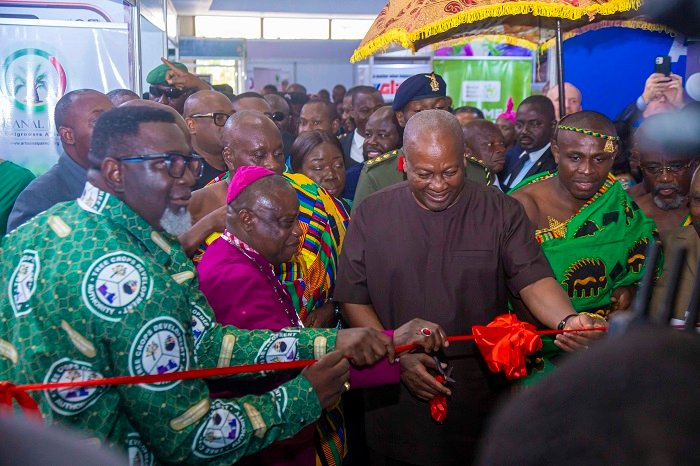
GHANA’S efforts to reposition its tree crop sector as a major pillar of economic transformation gained renewed momentum following the successful organisation of the maiden 2026 Tree Crops Development Authority (TCDA) Summit and Exhibition in Accra.
The four-day summit, held from February 17 to 20 under the theme: ‘Sustainable Growth through Tree Crop Investment: Resetting and Building Ghana’s Green Economy’, brought together investors, development partners, policymakers and agribusiness leaders to define a clear roadmap for long-term growth in the sector.
Addressing participants at the opening session, the President, John Dramani Mahama, underscored the need for Ghana to break away from the long-standing practice of exporting raw agricultural commodities.
“We will no longer export raw cashew,” President Mahama stated, adding that, “I invite our investment partners who export cashews to come and build the capacity to process our cashew locally. I want to travel and be able to buy cashew and see the produce of Ghana, challenging the produce of some other countries.”


He stressed that the country must take deliberate steps to process its own produce, build competitive brands, and retain greater value within the national economy.
The President also announced a $200 million government commitment to support tree crop development, with a focus on processing infrastructure, productivity improvement, and private sector participation.
The Minister of Food and Agriculture, Mr Eric Opoku, described the summit as a significant milestone in Ghana’s agricultural transformation agenda.
He outlined government’s plans to strengthen extension services, improve access to quality planting materials, expand out-grower schemes, enhance traceability systems, and promote exports into high-value international markets.
The minister stressed that the government is committed to repositioning tree crops from largely fragmented and raw commodity production into a modern, value-driven industry supported by strong regulation, investment, and processing capacity.
He explained that the transformation and resetting agenda would prioritise value addition, local processing, and the development of efficient supply chains to ensure that Ghana captures greater economic benefits from its resources.
Providing details on the summit’s outcomes, the Chief Executive Officer of the Tree Crops Development Authority, Dr Andy Osei Okrah, disclosed that the event attracted expressions of interest estimated at $500 million in potential investments across the tree crop value chain.
He further indicated that the authority is targeting $12 billion in annual revenue by 2030 from cashew, oil palm, shea, coconut, rubber and mango. This projection is expected to generate up to 500,000 jobs within the same period.
Dr Osei highlighted the authority’s strong focus on creating jobs for young people and empowering women throughout the tree crop value chain, especially in the shea sector, where women play the leading role in production and aggregation.
He explained that the Tree Crops Development Authority (TCDA) is rolling out training, logistical support, and cultivation programmes to help farmers improve productivity and increase their incomes.
According to the CEO, the authority had plans to roll out a flagship programme to develop 16,000 hectares of tree crop plantations across all 16 regions. Each region would concentrate on crops best suited to its ecological conditions. The initiative, he intimated, would create thousands of jobs, improve livelihoods in rural communities, and boost Ghana’s export potential.
The exhibition segment of the summit highlighted a growing range of locally processed products capable of competing with international brands, reinforcing Ghana’s readiness to move beyond raw exports toward value-added production.
BY CLIFF EKUFUL
Join our WhatsApp Channel now! https://whatsapp.com/channel/0029VbAjG7g3gvWajUAEX12Q

Follow the latest videos and updates on the official YouTube channel of Ghanaian Times.