Researchers, policymakers brainstorm AI applications to boost livestock production
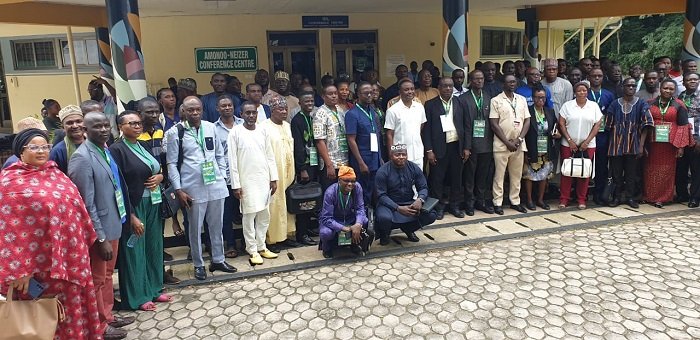
The future of animal agriculture in Africa took centre stage as leading scientists, policymakers and agribusiness experts gathered at the 3rd Joint Conference of the Ghana Society of Animal Production (GSAP) and the Ghana Animal Science Association (GASA), held at the Kwame Nkrumah University of Science and Technology (KNUST).
The conference, themed: ‘The Role of Animal Agriculture in National Development in an Era of Artificial Intelligence (AI),’ spotlighted the transformative potential of AI in reshaping livestock production across the continent.
Professor Nana Awusi-Mensah, Vice Dean of the Faculty of Agriculture at KNUST, delivered a compelling keynote address, emphasising AI’s capacity to revolutionise animal agriculture.
He highlighted how technologies like machine learning and predictive analytics could forecast poultry diseases, optimise cattle feed, and ensure equitable value chains for smallholder farmers.


“AI is not just a tool—it’s a catalyst for sustainable and efficient agriculture,” he stated.
Professor Awusi-Mensah urged researchers, policymakers, farmers, agribusiness leaders, and students to collaborate for practical AI applications to boost livestock production in Ghana and beyond.
He admitted challenges such as lack of investment but said “if stakeholders come together to pool resources, it will work”.
Professor Dadson Awunyo-Vitor, Provost of the College of Agriculture and Natural Resources at KNUST, described the conference as a pivotal moment where traditional farming practices intersect with digital innovation.
He stressed the need for bold thinking and realistic planning to integrate AI into Ghana’s agricultural framework. “We must envision a future where a farmer in Kumasi receives an SMS alert from an AI system detecting early signs of disease in their herd,” he underlined.
Prof. Awunyo-Vitor challenged scientists to move beyond the lab and engage directly with communities.
He also called on policymakers to create enabling environments through improved connectivity, funding, and regulation, stressing the importance of bridging the gap between AI researchers and the realities faced by farmers.
The Provost further recognised the vital role of farmers and students in driving the digital transformation, saying that “farmers are not just beneficiaries—they are co-creators”.
He then encouraged students to embrace their role as the digital generation poised to lead agriculture into the Fourth Industrial Revolution.
Adding a pan-African dimension to the dialogue, Professor Akinyele O. Kingsley Adesenhinwa, First Vice President of the Nigerian Institute of Animal Science, called for deeper collaboration between Ghana and Nigeria.
He emphasised that Africa’s growing population demanded more nutritious food, and AI offered the tools to meet that challenge. “AI is a game changer. We must invest in it—not just adopt it, but innovate and export our own solutions,” he urged.
Prof. Adesenhinwa proposed joint research initiatives between Ghana and Nigeria to develop homegrown AI applications tailored to the continent’s unique agricultural needs.
“Together, we can build smarter, inclusive, and resilient food systems for Africa…if Ghana and Nigeria lead the charge, the continent is poised to redefine livestock production—making it smarter, more sustainable, and globally competitive,” he intoned.
FROM KINGSLEY E. HOPE, KUMASI
🔗 Follow Ghanaian Times WhatsApp Channel today. https://whatsapp.com/channel/0029VbAjG7g3gvWajUAEX12Q
🌍 Trusted News. Real Stories. Anytime, Anywhere.
✅ Join our WhatsApp Channel now! https://whatsapp.com/channel/0029VbAjG7g3gvWajUAEX12Q