Rethinking Rice: How Ghana’s AWD revolution is saving water, securing the future of farming
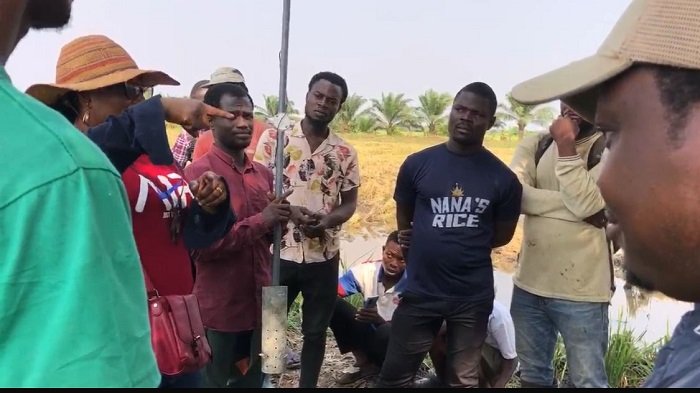
In Ghana’s Weta rice belt in the Volta Region, a quiet revolution is taking root—one that promises to redefine how rice is grown in our water-stressed, warming world. Through a pioneering collaboration between UK and Ghanaian scientists, rice farmers are embracing a climate-smart innovation called Alternate Wetting and Drying (AWD), a scientifically validated irrigation technique that conserves water, slashes greenhouse gas emissions, and enhances crop resilience without sacrificing yield.
At the centre of this ground breaking initiative is a £220,000 grant from Innovate UK’s African Agriculture Knowledge Transfer Partnership (AAKTP), driving a tripartite collaboration among Lancaster University, the Crops Research Institute of the Council for Scientific and Industrial Research (CSIR-CRI), and Newage Agric Solutions Ltd. Together, they are not only refining AWD for Ghana’s unique agro-ecological conditions but also advancing the global scientific discourse on sustainable rice production as part of a broader movement to redefine agricultural sustainability in West Africa.
Rice is the staple that feeds more than half the global population. But the way it’s traditionally grown—through continuous field flooding—comes at a staggering cost: 3,000 litres of water to produce one kilogramme, and massive emissions of methane, a greenhouse gas far more potent than CO₂.
“We were drowning our fields and suffocating our planet,” says Dr Stephen Yeboah of CSIR-CRI. “Our methods nurtured crops, yes—but also fuelled environmental collapse.”


Traditional rice paddies, perpetually flooded, create perfect conditions for anaerobic bacteria that produce methane. These waterlogged fields contribute nearly 12 per cent of global agricultural methane emissions, making rice cultivation a significant driver of climate change. The environmental footprint is massive, and with climate change accelerating and water resources dwindling, this centuries-old practice has become unsustainable.
AWD breaks with tradition by allowing fields to dry periodically before re-irrigating. This simple act transforms the biology of the soil—oxygen returns, methane production plummets, and water is used far more efficiently. When fields are allowed to breathe, the entire underground ecosystem shifts from anaerobic to aerobic conditions, dramatically reducing the microbial processes that generate methane.
The impact is nothing short of remarkable: up to 30 per cent water savings without sacrificing yields. In some areas, shortened crop cycles even enable double cropping, transforming agricultural economics for smallholder farmers.
“It’s not just irrigation—it’s an ecological reset,” explains Dr Yeboah. “We’re enabling the soil to heal while still feeding our communities.”
AWD’s power lies in its fusion of ancestral farming wisdom and cutting-edge technology. Real-time monitoring systems, including soil sensors and tensiometers, offer precise data on soil moisture levels, pinging alerts to farmers’ mobile phones when it’s time to irrigate. This precision agriculture approach eliminates guesswork and maximises efficiency, ensuring every drop of water serves a purpose.
“It’s like having a conversation with the earth,” says Vincent Opoku Agyemang, a KTP Associate who leads field trials across Weta’s 2,340 acres of irrigable land. “The land speaks, and we’ve finally learned to listen.”
Professor Ian Dodd, plant physiologist at Lancaster University, highlights AWD’s profound effect on rice plant development. “By allowing roots to periodically search deeper for moisture, AWD stimulates adaptive stress responses—leading to more robust growth, better drought tolerance, and more efficient water uptake.”
This physiological reprogramming represents a fundamental shift in how we understand plant resilience. The mild stress induced by periodic drying doesn’t weaken the plants but actually strengthens them, triggering biological adaptations that make them more resilient to environmental challenges.
“The commercial sector has shown significant interest in trialling AWD on much larger scales, which formed the foundation for the successful bid for Innovate UK funding with Newage Agric Solutions Ltd”, notes Prof. Dodd.
Field trials using popular Ghanaian rice varieties like CRI-AGRA are already delivering stunning results backed by findings from the earlier RECIRCULATE project (https://recirculate.global/) under the UK’s Global Challenges Research Fund (GCRF)—a major international research and knowledge-exchange collaborative partnership between Lancaster University researchers and a growing pan-African network of research-led institutions, which has led to the formation of the Africa Research and Innovation Partnership (ARIP) network (https://www.arip.network/).
“This stress training toughens the plants,” Prof. Dodd explains. “They become better adapted, just like people do when tested by challenges.”
The trials demonstrate not only consistent yields under AWD management but also shortened growth cycles, enabling double-cropping opportunities and more flexible planting seasons. This flexibility is particularly crucial as Ghana expands rice cultivation strategies for both wet and dry seasons, providing farmers with greater food security and income stability.
“This is science in action,” says Eugene Zori, Technical Director at Newage Agric Solutions Ltd. “We’re transforming cutting-edge research into practical reality to drive sustainable growth and resilience in the agricultural sector—and the results are stunning.”
The AWD project exemplifies what genuine international partnership looks like in the 21st century. Lancaster University brings global research excellence and scientific rigor. CSIR-CRI offers invaluable local insight, cultural understanding, and farmer trust. Newage Agric Solutions bridges the critical gap between laboratory science and market realities. Most importantly, farmers themselves are not merely beneficiaries but active co-designers of solutions.
“This isn’t foreign aid—it’s shared ownership of innovation,” emphasizes Zori. “We don’t impose solutions from the outside. We collaborate, we listen, we adapt, and we create together.”
According to Dr. Patricia Amankwaa-Yeboah at the CSIR-CRI, “It’s great to work with Newage Agric Solutions Ltd. to translate research output to smallholder farmers in Weta. We look forward to sharing our expertise on water and nutrient innovations in rice production to contribute to Vincent’s development as a KTP Associate.”
General Manager at Newage Agric Solutions Ltd, Martin Nartey, reinforces this collaborative spirit: “Our collaboration with Lancaster University and CSIR-CRI is a testament to the transformative power of unity in advancing agricultural science and technology. By merging academic excellence with cutting-edge research and industry expertise, we’re ensuring food security for generations to come.”
Beyond Ghana’s borders, the implications are global. AWD, if scaled, could cut rice-related methane emissions in half—equivalent to removing over 100 million cars from roads each year. This represents one of the most significant mitigation opportunities in agriculture, shifting rice cultivation from a climate liability into a climate solution.
Moreover, AWD supports multiple Sustainable Development Goals—advancing climate action, promoting zero hunger, ensuring responsible water use, and fostering sustainable economic growth. Its emergence also coincides with the 50th anniversary of the UK’s Knowledge Transfer Partnership (KTP) programme, highlighting a new era of innovation that directly benefits farmers and the planet.
While the benefits are clear, adoption challenges remain—especially for smallholders. Sensors, though effective, remain costly.
As one farmer in Weta put it, “The sensor is good, but too expensive for a smallholder farmer. Unless it’s subsidized, many of us can’t afford it.” Others shared how AWD helped them conserve water and even increase yields, despite initial fears that drier fields might harm the crop.
Still, the momentum is undeniable. As Martin Nartey puts it: “Sustainability isn’t a burden—it’s an opportunity. AWD proves that what’s good for the planet can also be good for farmers’ prosperity.”
This is the future of agriculture: rooted in science, grounded in community, and growing toward a more resilient world.
BY KINGSLEY E. HOPE