CONTROVERSIES in Ghana’s rubber space deepen as the Rubber Farmers Association of Ghana (RUFAG) and actors have petitioned the President to reject calls for the total ban on export of the valuable product.
“Calls have been made for a complete ban on raw rubber exports. We wish to state categorically that these claims are false, self-serving, and do not reflect the realities of Ghana’s rubber industry,” they stressed.
They referred to statements that alleged that “unchecked” exports of raw rubber undermine local processing, threaten Ghana’s industrialisation agenda to create jobs and also cause annual losses of up to $100 million.
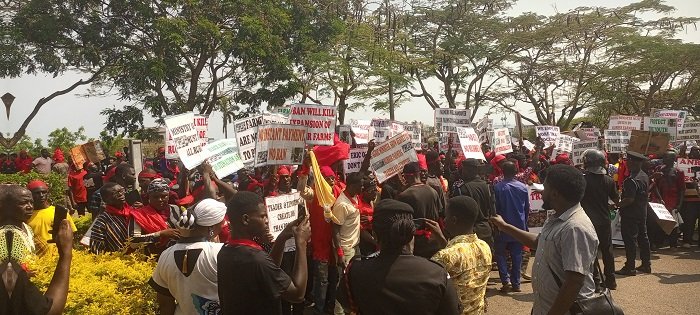
RUFAG and actors made these arguments when they held a demonstration in Takoradi yesterday, in response to public statements by Ghana Rubber Estates Limited (GREL), the Rubber Processors Association of Ghana (RUPAG), the Western Regional House of Chiefs, and the Ranking Member of Parliament’s Trade and Industry Committee, Michael Okyere Baafi.

The petition was copied to the Minister of Trade, Industry and Agribusiness, Minister of Food, Agriculture and Cocoa Affairs, the Tree Crop Development Authority (TCDA), and the Parliamentary Select Committee on Trade Industry and Agribusiness.
Under police escorts, the groups, from Western and Central regions, clad in red bands, amidst ‘jama’ songs, and holding placards some which read “Mr President listen to rubber farmers too”, Mr Agric Minister, show respect to rubber farmers, traders and exporters”, “Farmers will hand over their farms to galamseyers, if you ban exports”, let’s save the rubber industries now!”, marched from Fijai through Adiembra to the Western Regional Coordinating Council (WRCC).
The Secretary of RUFAG, Michael Nyarku, presented their petition to the Western Regional Minister, Mr Joseph Nelson.
The RUFAG group maintained that, the processes operated under an existing regulated regime approved by the government.
“The system promoted competition, market balance, and transparency, prevented price manipulation and protected the livelihoods of hundreds of thousands of farmers and workers across the rubber value chain,” they explained.
Furthermore, TCDA directive issued on May 2, 2025, required all exporters of unprocessed rubber, cashew, and shea to be registered, licensed, and issued permits before export.
“This directive is strictly enforced in collaboration with the Customs Division of the GRA, the Ghana Ports and Harbours Authority, security agencies, and other relevant regulatory institutions,” RUFAG actors reported.
They also noted that the push by processors for export ban of rubber was a “pretense of protecting national industrialisation” and “a deliberate attempt to monopolise the market, suppress competition, and force farmers to sell rubber cup lumps at artificially low prices.”
Experience, they emphasied, showed that restrictions on competition, ensured processors dictated prices whiles farmers suffered and rural livelihoods collapsed.
They described arguments that processors were the main drivers of employment as “grossly distorted”, and that, they employed fewer than 1,000 workers, while rubber farming and trading ecosystem sustained livelihoods of over 300,000 rubber tappers.
Any policy decision that would lead to monopoly pricing and reduced farm-gate prices, the RUFAG actors added, would destroy jobs, deepen rural poverty, and undermine social stability in rubber-growing communities.
“Ghana’s industrialisation agenda must be inclusive and farmer-centred and not driven by narrow corporate interests,” RUFAG stated, saying that “allegations of raw material shortages are, therefore, misleading.”
FROM CLEMENT ADZEI BOYE,
SEKONDI
🔗 Follow Ghanaian Times WhatsApp Channel today. https://whatsapp.com/channel/0029VbAjG7g3gvWajUAEX12Q
🌍 Trusted News. Real Stories. Anytime, Anywhere.
✅ Join our WhatsApp Channel now! https://whatsapp.com/channel/0029VbAjG7g3gvWajUAEX12Q