Stakeholder Platform Launched to Support Tree Tenure Reforms
A stakeholder platform to support Ghana’s tree tenure reforms has been launched.
The project, funded by the European Union, is being implemented under the European Forest Institute programme, Support to FLEGT-related Multi-stakeholders and Non-State Actor Participation in Tree Tenure in Ghana.
The programme, in partnership with Taylor Crabbe, Eco Care Ghana, Nature and Development Foundation, Tropenbos Ghana and Rights and Advocacy Initiatives Network, seeks to strengthen multi-stakeholder participation in implementing the FLEGT Voluntary Partnership Agreement.
The aim is to enhance the capacity of non-state actors to engage meaningfully in ongoing tree tenure policy reforms in Ghana.

The platform is expected to monitor legality compliance and undertake independent timber validation audits to ensure transparency and accountability.
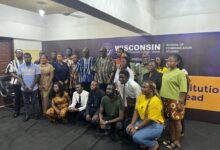
• Stakeholders at the launch. Photo: Seth Osabukle
The Technical Director of Forestry at the Ministry of Lands and Natural Resources, Mr Joseph Osiakwan, described the launch as a significant moment in Ghana’s forest governance journey. He said the country officially commenced the issuance of FLEGT licences in August 2025, marking a historic milestone under the Ghana–EU Voluntary Partnership Agreement.
He noted that the achievement makes Ghana the first country in Africa and the second globally to issue licences verifying the legality of timber exported to the European Union.
Mr Osiakwan said this phase was critical and placed heightened importance on strong, inclusive and well-functioning multi-stakeholder platforms, which were indispensable for effective monitoring, problem-solving, public trust and the delivery of tangible benefits across the timber value chain.
According to him, tree tenure reform remained one of the most persistent structural challenges in Ghana’s forest landscape, as insecure and unclear tenure arrangements continue to undermine farmer incentives, forest restoration efforts and sustainable land-use practices, particularly in off-reserve areas.
He said the government was advancing transformative reforms to address longstanding challenges, including a groundbreaking proposal to grant farmers benefit rights to naturally occurring trees on their farms.
“This represents a fundamental shift in tree tenure policy and recognises farmers as rightful custodians and beneficiaries of trees they plant, nurture and protect on their lands,” he said.
Mr Osiakwan said the government was implementing a comprehensive digital tree registration system to identify and document tree ownership.
The system is intended to establish clear ownership rights, reduce conflicts over tree resources, facilitate benefit-sharing arrangements and provide the data infrastructure necessary for transparent forest governance and legal timber trade.
He explained that the exercise would create an authoritative record of ownership and location, removing the ambiguity that has historically plagued off-reserve forest management, strengthening forest governance architecture and ensuring that legal timber trade is built on secure and transparent tree tenure.
Ms Caroline Haywood, Contract Manager of the programme, said in a virtual presentation that the initiative would help prevent deforestation, biodiversity loss and forest degradation threatening the ecosystem.
She said the time had come to engage key experts to address tree tenure issues, particularly clarity of ownership.
BY LAWRENCE VOMAFA AKPALU, Accra
Follow Ghanaian Times WhatsApp Channel today. https://whatsapp.com/channel/0029VbAjG7g3gvWajUAEX12Q
Trusted News. Real Stories. Anytime, Anywhere.
Join our WhatsApp Channel now! https://whatsapp.com/channel/0029VbAjG7g3gvWajUAEX12Q