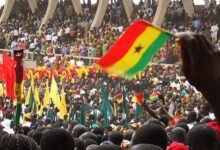
The aftermath
During the transition in the aftermath of polls, three constants take centre stage: celebrations, recriminations and retributions. They last the period until the dusts settle. But these are succeeded by fault-finding which is, both narrow-minded parochialism, complaining almost ad infinitum and put distances not far off a ferocious syndrome. The country is a witness. The results are the audience get fed up to the gum of tooth and translated in Fantse, it is said “Aye tse”—‘you are hackneyed.’
The repercussion in political history is becoming a liability both to yourself and the cause you either, or, pretend to represent. That becomes an agonising albatross. Of all among the phenomena in post-ballot is the combination of joy and attrition flowing from the triumphal exuberance which develops into excess per se and has in its growth, the incidences of hard backlashes such as the Youth particularly have demonstrated, if un-sobered. The causes are pent up anger and tit-for-tat correspondingly. We are witnessing all as the hit-back assumes the fury of violence. As inevitably as there are, you would find that they are not necessarily planed— simultaneous eruption.
But everything about their inevitability should be anticipated to moderate or indeed pre-empt, because damage-repair is costly financially and image denting. Putting aside all that book-long, it is harsh for anyone to tolerate, let alone reconcile with the proven or the suspect and or even a mere connectible for a fall. This is driving force in the rows after the recent elections. But in a situation we become enemies, each of another, we set ourselves en route to ultimate perdition rather than preach ‘’now is the time ‘’ to unite, practicing the reality of ‘’audi alterem partem’’—‘listen to the other party’. It is recalled that the country had before 2000, hankered after what is called ‘’INCLUSIVENESS’’. The first publicly announced trial was un-successful under President John Kufuor2000-2008. Political leaderships had forgotten that Osagyefo Dr Kwame Nkrumah had given greater examples of appointing MERIT over party politics. I am reading signs of reinstatement of that preference wherever possible in the new administration, forming.
There are two considerations for what would be described as heresy, according to where we have driven our politics. Let it boldly accepted that one of the dangerous evils politics clothed was the POLITICISATION of state institutions. Firstly, enough bills have been paid to date for that crude side of partisanship in this country. My comment with hindsight schooling is that politics have undone this country caught itself believing that only our party’s brand of politics has the only think-tanks to deliver. I shall use a foreign and Home histories to make the point poignantly. British Prime Minister Harold Macmillan appointed Lord Robens to head the Coal Board. Harold was Conservative; Robens, a Labourite. This was the period of Britsh history the Unions powerfully controlled Labour. How dared Macmillan? but Robens’ record of great success remains.

He worked for his country and everyone acknowledged that scuttling politics of “Them” and “Us”, which for us here is a blocked separation. Then during the Third Republic, President Dr Hilla Limann (ruling PNP) appointed a Mr Richardson to head the Ghana Airways Board. The man was not CPP which the PNP was its incarnate. Richardson achieved the first-ever profit for the Corporation in years since its establishment.
Next, the whole mistake in business of only for the ‘’Party Boys’’ was ditched. In fact the PNP hierarchy addressed a protest news conference at Arden Hall old Ambassador Hotel. Likewise there being “Meritocrats” in other instances from between the Westminster Democracy 1957 to Republicanism 1960. In that same act, debauched until now, political leaderships might have been pressured by the literary meanings of the “50 plus one percentage- creed” could be faulted for the decades of leaving out to tap that field of ability. This omission counts as significant, as source of our slips, crept into a detriment against progress. Thus, gave birth to the split of the nation which has retrogressively turned an error into a norm today.
Historically the divide has only been widened down the middle and maybe became recently finessed. I imagine the Constitutional Review will take it seriously addressed. They have an extremely intricate subject to handle on its own. While I wish them well prayerfully confessing, it behoves to warn them to stand political interests et al blind befuddle them to acquiesce on issues which have come back to haunt and or physically raised ugly heads—Youthful rioting reportedly. The situation would not have deteriorated if the Constituent Assembly 1979 had not been overwhelmed by the Lobby of eager and would-be politicians within and without. With regard to specifically the spate of arsons breaks into and seizures attributed to political counter accusations,
I also would direct attention to the recent Bole-Bamboi -(Tatale ) initiative and solution. Behind that quelling are quiet engagements and hard work intelligence, a sine qua none. It is a model applicable— wherever during a wave of youthful exhibition of the three constants stated earler. It is pertinent to recall another sense, sui generis and opportunity lost by the same constitutional crafting body which I had referred previously. The heated arguments were about the position or, indeed the appointments of Deputy Ministers. Firstly, the Technocrats wanted the job done by then prove Techs corresponding to any particular ministry or in their absence by Principal Secretaries. That would either move lots of the purely administrative lot or even away from the centre. It is a pleasant observation that some non-MP Ministers shall have no Deputies. I hope the selection would be based on proven know-how to fit each ministry, a magnificent sideways walking to enable quicker and efficient work ethics that would, secondly, foster cutting out the passengers of visitors [the fixer group or brigades of connection persons] to ease out corruption and free the bureaucracy to deliver— cost-saving notion and speedy efficiency. I think there is plenty of knowledge to get round it in this country, not a copy of anyone else’s.
When all the dusts subside, there is a seasonal phenomenon that either competes with scientific psepsology in electioneering— punditry calls it opinion polling and prophesying which crosses the former without being so, it seems effectively. No other election in our democratic journey has been more than buffeted by prophecies. On the contrary, I recently heard Pastor Mensah Otabil critically speaking about the rise and frequencies of prophecies and I think he was showing concerns not about predictions not going impeccable; but I would believe in his reeling of old Testament Prophets warning of lest ‘’aye tse’’ ripples and wondering about present days’ sanctity. Without trying to match him, the scenario was pointing to St James’ “from whence cometh….” (Chap 3). I stand to be corrected.
Changing the gear towards conclusion, I had some three or four columns stated there will be all kinds of literature on the immediate past regime an old but perhaps obsolete English saying is “carrying coals to Newcastle” “obsolete because coal fuel is shut down. But its idiomatic meaning being repetition, would justify an embargo on relaying any of those words or sentences used to relay pouring blame and scorn; except to repeat what has happened and rest interpretation. But there is a veritable complaint buried in the bosom of the Ghanaian stoicism: that the political breed would heed to the people.
However, there would be some of more of such coming– no prophecy. It is a usual occurrence after ballots, which puzzles and makes good and bad guys. Historians though are able to decode them into fine or very rarely raw narratives for posterity. Some may distil or and others would keep the controversies. It’s not all over yet.
(c) Prof Nana Essilfie-Conduah.