The perennial floods in Ghana: The need to ‘desilt’ the mind
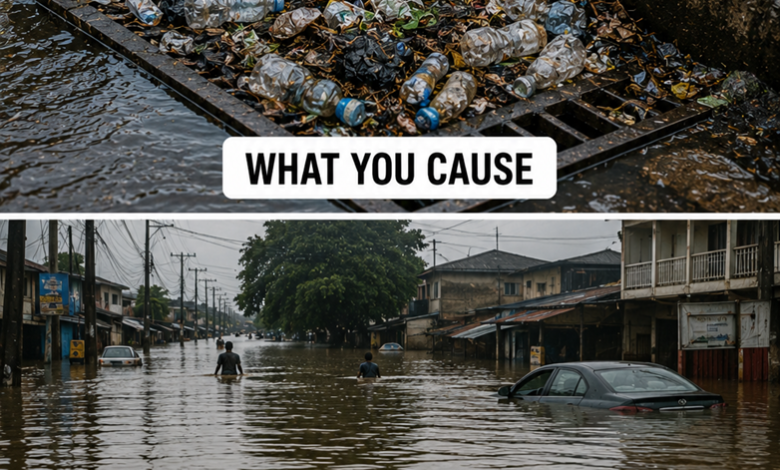
It is the mind and the attitude not the gutters!!!!
The mind is the leader or forerunner of all actions (Meyer, 2002). She continues to say that ‘our actions are a direct result of our thoughts’. If we have a negative mind, we will have a negative life. If, on the other hand, we renew our mind according to God’s Word (Romans 12:2), we will prove up in our actions and experiences. “Ghana does not only need to desilt gutters; we need to desilt the minds of its citizens.”
It is sad to say that the issue of flooding in Ghana, especially in some parts of the capital city, has persisted over the years. Every rainy season brings anxiety, destruction and sorrow. Floods continue to claim human lives, destroy homes and businesses, damage roads and bridges, and consume a substantial portion of the nation’s financial resources that could otherwise be invested in national development, such as education and healthcare.
The history of flooding in Ghana demonstrates that this is not a new phenomenon. Records show that major floods have occurred repeatedly over the decades, causing loss of life, displacement and extensive damage to property. In 1995 and 1997 alone, severe floods affected thousands of people and destroyed homes and infrastructure. Between June 1995 and May 2010, numerous devastating floods were recorded across the country. In November 2001, a single flood incident reportedly left over 43,000 people homeless. Similar disasters occurred in subsequent years, including the well-known floods of June 2010 and June 2016. These recurring events confirm that the current flooding in Ghana is not exceptional or unexpected; rather, it has become a persistent national challenge. Whenever these disasters occur, lives are lost, families are displaced and relief support is provided by NADMO and other institutions to assist affected communities.

Whenever flooding occurs, pragmatic measures are quickly put in place. Emergency resources are dispatched to affected communities. The National Disaster Management Organisation (NADMO), sometimes supported by banks, insurance companies, churches, NGOs and other corporate institutions, distribute relief items to victims. Communities organise communal labour to clear choked drains, while metropolitan, municipal and district assemblies embark on the desilting of gutters and drainage systems.
These interventions are necessary and deserve commendation. However, despite all these efforts, the problem persists. Year after year, we repeat the same cycle: the rains come, floods occur, relief is provided, gutters are desilted, promises are made, and after a few months we are back to where we started.
This raises an important question: Are we treating the symptoms instead of addressing the root cause?
On May 27, 2026, His Excellency John Dramani Mahama made a profound observation on TV3 that the flooding issue in Ghana is not entirely an engineering problem; it is a matter of human attitude.
I wholeheartedly agree with this.
My conviction is deeply rooted in a philosophy I learnt from my late mother. She always said, “It is not the hand that works but the mind (or brain).”
The hands cannot pick a piece of paper from the ground unless the mind first decides to do so. The feet cannot walk to the nearest refuse bin unless the mind gives the instruction. The eyes may see an empty sachet lying on the street, but unless the mind is disciplined, the hands will never pick it up. In essence, behaviour is controlled not by the limbs but by the mind.
This explains why I strongly believe that Ghana needs to desilt the mind before the gutters.
We all know that health is wealth. No normal human being deliberately chooses sickness instead of good health or poverty instead of prosperity. We believe that God created us in His own image and endowed us with wisdom, conscience and the ability to make responsible choices. The Bible reminds us that God gives us the power to create wealth (Deuteronomy 8:18). A healthy environment is one of the foundations of national wealth because disease, disasters and environmental degradation rob individuals and nations of their productivity.
“Cleanliness is next to godliness,” is a popular saying that repeatedly teaches holiness, orderliness and good stewardship. God entrusted His creation to mankind to manage responsibly, not to abuse it. Therefore, the ability to maintain a clean and healthy environment begins in the mind long before it is reflected in our surroundings.
For this reason, I submit that we should desilt the mind rather than merely desilt the gutters.
Gathering resources to desilt gutters will produce only temporal results if people’s attitudes remain unchanged. Gutters that are cleaned today can easily become clogged tomorrow if citizens continue to dump refuse into them. Which one has a more lasting effect; desilting the mind or desilting the gutters? The answer is obvious. A transformed mind produces transformed behaviour, and transformed behaviour protects the environment.
If we desilt our gutters a thousand times without changing people’s attitudes, flooding will continue and may even worsen as our cities become more populated. It is painful to watch people finish drinking sachet water or bottled water and casually throw the empty sachets and bottles onto the streets. Some even throw rubbish from moving vehicles without any sense of responsibility. Ironically, many of these same individuals become victims whenever floods occur.
The campaign to desilt the mind should begin at home.
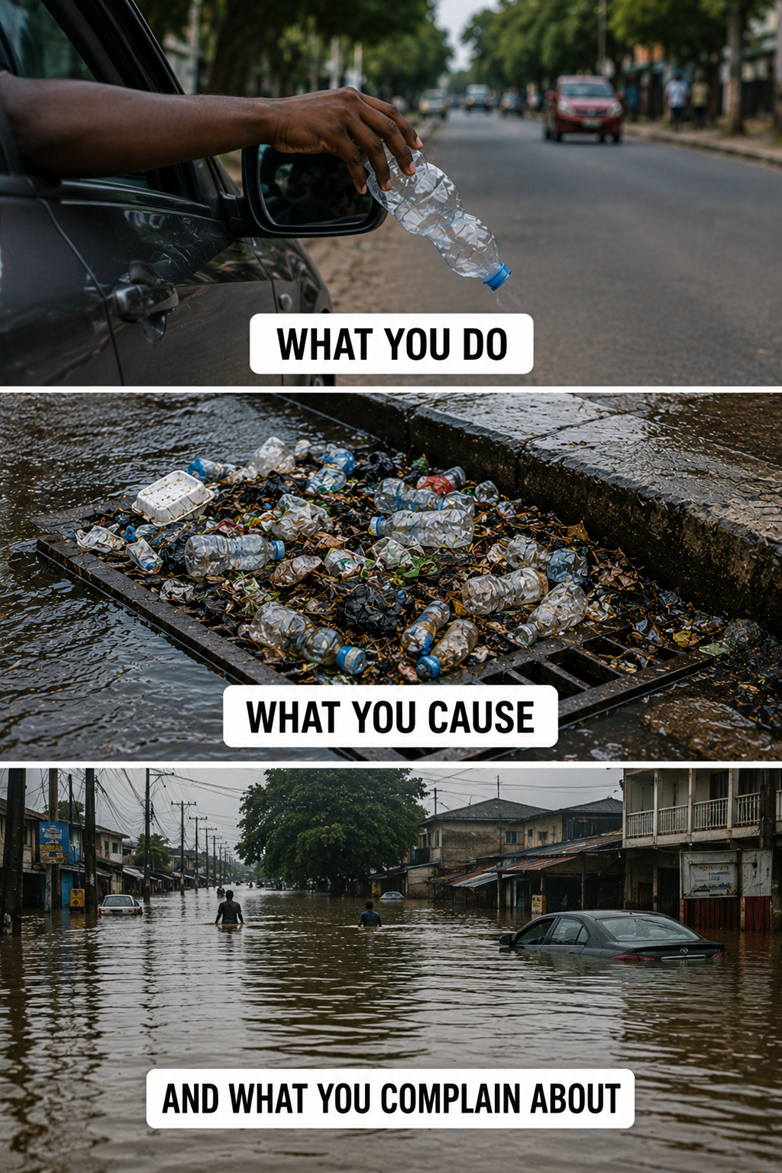
(AI generated image)
Responsible parenting starts long before a child enters nursery school. Parents must deliberately teach their children where to dispose of empty sachets, bottles, food wrappers and other waste materials. Children imitate what they observe. If parents litter indiscriminately, children will most likely do the same.
Schools must reinforce these values. Effective teaching and learning go beyond reading, writing; they include character formation and responsible citizenship. Environmental cleanliness should be part of everyday school life and not merely a topic taught during Environmental Studies lessons.

Sadly, poor environmental attitudes are found even among the elite. Even university students finish drinking sachet water or bottled drinks and leave the empty containers on lecture theatre floors, staircases and desks. On several occasions, I have personally had to pick up such litter.
The call to desilt the mind extends to our transport terminals. At many lorry stations, drivers, drivers’ mates and passengers litter the stations and adjoining roads with little concern for cleanliness. Some drivers’ mates sweep rubbish from inside their vehicles only to empty them into nearby gutters or open spaces.
I once heard someone justify this behaviour by saying that if people stopped littering, sanitation workers would lose their jobs. Such reasoning demonstrates precisely why our minds need desilting.
Markets, beaches, schools, churches, mosques, offices and even some homes are not exempt from this problem. Some people sweep refuse from their compounds onto public roads under the cover of darkness, believing that the rains will wash them away. Indeed, the rains do wash them into our gutters, streams and rivers, where they eventually cause blockages and flooding.
Government also has a significant responsibility. Environmental sanitation by-laws must be enforced without fear or favour. People who dump refuse into drains, build on waterways or violate sanitation regulations should face the full rigours of the law regardless of their political affiliation. Waste bins should be provided in strategic public locations, and waste collection services should be improved. However, government cannot assign a police officer to every street corner or behind every citizen. Individual responsibility remains indispensable.
The media, religious organisations, traditional authorities, schools, civil society organisations and community leaders must all become ambassadors of environmental discipline. Churches and mosques should preach stewardship of God’s creation alongside spiritual development. Traditional leaders should revive communal values that promote cleanliness. The media should sustain public education on environmental responsibility throughout the year rather than only during the rainy season.
Land owners in their right “mind” are to stop selling lands in water ways. We are also pleading with some contractors to judiciously and responsibly utilse resources / monies given them for road works.
Imagine a Ghana where every citizen instinctively carries waste to the nearest bin; where children politely remind adults not to litter; where transport operators take pride in maintaining clean stations; where traders compete to keep their surroundings clean; and where environmental cleanliness becomes a national culture rather than an annual campaign. Such a Ghana is possible, but it begins with a change of mindset.
The real solution to Ghana’s perennial flooding does not lie only in bigger drains, more excavators or more desilting exercises. It lies in transformed minds.
If we desilt the gutters without desilting the mind, we are merely postponing the next disaster. But if we desilt the mind, the gutters will remain clean because responsible people do not deliberately pollute their environment.
As my late mother wisely taught me, it is not the hand that works; it is the mind. When the mind is desilted, the hands will pick up the litter, the feet will walk to the nearest bin, parents will train their children well, schools will reinforce good habits, and communities will take ownership of their environment.
The writer is a retired senior lecturer of the University of Education, Winneba
Follow our WhatsApp Channel now! https://whatsapp.com/channel/0029VbAjG7g3gvWajUAEX12Q