Use AI to build a just society, not just careers – Pro Nsowah-Nuamah
The President of Southshore University College, Professor Nicholas Nsowah-Nuamah, has advised students to use Artificial Intelligence (AI) not merely to advance their careers, but to improve lives, strengthen communities, and help build a more just, inclusive and humane society.
He said AI was already transforming how businesses operated, how doctors diagnosed diseases, how engineers designed solutions, how researchers made discoveries, and even how students learned.
He however, added that this revolution could be channelled towards making meaningful contributions to society.
Speaking at the college’s 10th graduation ceremony in Accra yesterday, Professor Nsowah-Nuamah said tasks that once took hours could now be completed in minutes, and information that once took days to gather was now available in seconds.


Even so, he cautioned, students needed to learn how to use these tools wisely.
He stressed that in the age of AI, competence meant more than simply possessing knowledge. With information now abundant and intelligent systems able to retrieve facts almost instantly, he said, students needed to embrace AI to stay ahead.
“The pace of change is accelerating, and the future is arriving faster than many imagined. The question, however, is not whether AI will change the world. It already has. The more important question is: what kind of people will guide that change?”
“The graduates who will thrive are not those who merely know the answers, but those who know how to ask the right questions, evaluate information critically, solve complex problems, and apply knowledge wisely,” Professor Nsowah-Nuamah said.
He pointed out that while a degree was evidence of competence, it should also serve as a foundation for continued learning, noting that many of the jobs, technologies and opportunities of the next decade did not yet exist.
“Therefore, the greatest professional advantage will not be what you know now, but your capacity to keep learning, adapting, and innovating throughout your life. However, competence alone is insufficient. The AI revolution also demands courage.
“It takes courage to challenge misinformation generated by technology. It takes courage to question systems that may be efficient but unjust. It takes courage to insist on truth when misinformation spreads rapidly and to defend ethical principles when convenience suggests otherwise,” he said.
The Vice Dean of the School of Graduate Studies at the University of Cape Coast, Professor Emmanuel Saboro, observed that the world was undergoing rapid technological, social and economic transformation, driven by advances in AI and digital innovation.
He said students’ success would depend not only on the knowledge they had acquired, but also on their ability to think critically, adapt continually, and embrace lifelong learning.
Professor Saboro added that society expected graduates to apply their knowledge and skills to tackle current challenges, create opportunities for others, and contribute meaningfully to national and global development.
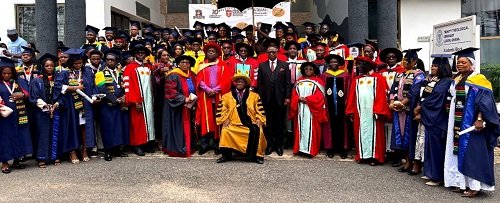
In all, 62 students met the academic requirements for the award of certificates, bachelor’s, master’s and doctoral degrees. The ceremony was held under the theme: ‘Character, Courage, and Competence: A Purposeful Path Through the AI Revolution.’
Y BERNARD BENGHAN
Follow our WhatsApp Channel now! https://whatsapp.com/channel/0029VbAjG7g3gvWajUAEX12Q