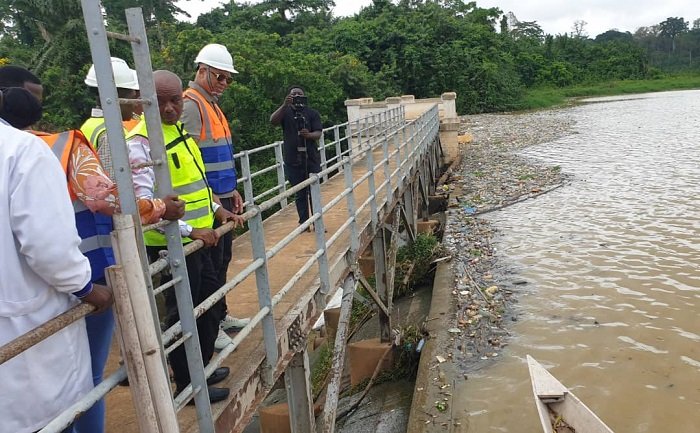
Kumasi and its adjoining communities may face an imminent water crisis due to the deteriorating state of the Owabi and Barekese dams, the Managing Director of Ghana Water Limited (GWL), Mr Adam Mutawakilu, has warned.
He said the two critical reservoirs, which together supply nearly 70 per cent of potable water to the metropolis, were under severe threat from siltation, pollution and encroachment, raising fears of a major disruption in water supply if urgent action was not taken.
Speaking during a tour of the facilities in Kumasi, Mr Mutawakilu disclosed that the once-pristine Owabi Dam had been heavily choked by silt and plastics washed in from nearby settlements, particularly during rainfall.
The Managing Director noted that the situation had become so dire that staff of GWL now resort to paddling canoes across the dam to manually remove floating debris.

“The overflow of water is deceptive. It is not a sign of abundance, but an indication of a clogged and weakened dam due to years of neglect,” he stated.
Mr Mutawakilu further revealed that the Barekese Dam, the larger of the two, was also facing a similar challenge, with significant portions of its depth lost to siltation.
As a result, he said water extraction for treatment had been limited to the shallow, middle and upper levels.
He warned that the situation posed a serious risk in the face of climate change, stressing that a prolonged drought could lead to the complete drying up of the dams, leaving Kumasi without a reliable water source.
In view of this, Mr Mutawakilu said GWL had formally requested immediate authorisation from the Ministry of Finance to undertake dredging of both dams.
“Without this intervention, Kumasi risks running out of water within the next three years,” he cautioned.
The Managing Director also lamented persistent power fluctuations, indicating that in March this year, output dropped to 959 cubic metres due to unstable electricity supply.
He, however, expressed optimism that production would improve following assurances from the Electricity Company of Ghana to provide a dedicated transformer to stabilise operations.
Mr Mutawakilu further underscored the need for collaboration with security agencies to curb encroachment around the dams, which he identified as a major contributor to pollution and degradation.
Earlier, the Ashanti Regional Chief Production Manager of GWL, Dr Hanson Akutteh-Mensah, described the situation as alarming, revealing that the Owabi Dam was about 75 per cent silted, while Barekese stood at 40 per cent.
He announced that plans were underway to install three additional clarifiers at the Barekese treatment plant to increase daily production capacity from 30 million gallons to 48 million gallons.
Despite these measures, Dr Akutteh-Mensah cautioned that without dredging, the Barekese Dam could dry up within three years if current climate conditions persist.
He stressed that protecting the dams was essential to safeguarding public health, livelihoods and the future of millions of residents in Kumasi.
FROM KINGSLEY E. HOPE, KUMASI
Follow our WhatsApp Channel now! https://whatsapp.com/channel/0029VbAjG7g3gvWajUAEX12Q