The New Patriotic Party (NPP) Minority in Parliament has raised concerns about the state of Ghana’s economy ahead of the government’s 2026 Mid-Year Budget Review, arguing that the gains being reported are largely the result of reduced spending rather than genuine economic improvement.
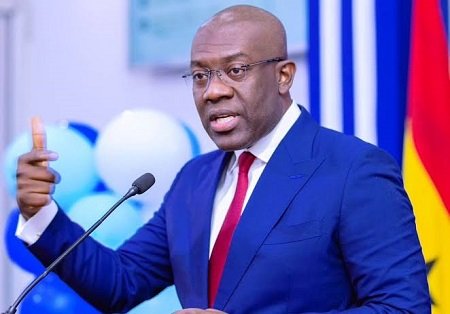
Addressing a press conference in Accra yesterday, the Chairman of the NPP’s Finance and Economy Policy Committee and Member of Parliament for Ofoase Ayirebi, Kojo Oppong Nkrumah, said the Minority’s assessment was based on the government’s own published economic data.
He explained that the party’s review focused on three key areas: the methods the government is using to achieve its macroeconomic targets, whether those measures are sustainable, and key development challenges the government has failed to address.
Mr Oppong Nkrumah argued that although the government is expected to announce a primary fiscal surplus of 2.6 per cent of Gross Domestic Product (GDP), the figure was achieved by cutting spending instead of increasing revenue.


According to him, revenue fell short of the revised target by about 4.7 per cent, while expenditure was reduced significantly, delaying important development projects.
“In simple terms, the government did not collect more revenue than expected. It simply spent far less than it planned,” he stated.
He added that capital expenditure was about 41 per cent below target in the first quarter of 2026, while spending on roads, schools, hospitals, foreign-financed projects, goods and services, as well as grants to the health, education and district sectors also fell below budgeted levels.
Mr Oppong Nkrumah maintained that reducing expenditure to create a fiscal surplus was only postponing projects that would eventually have to be completed.
On government arrears, he questioned the Finance Ministry’s figures, saying there were inconsistencies in the reported amount owed by the state.
He noted that although the government initially announced arrears of GH¢67 billion before revising the figure to GH¢45 billion after an audit, several sectors, including roads, continue to report huge outstanding payments.
He called on the Finance Minister to clearly explain the current stock of arrears and the methodology being used to calculate them during the Mid-Year Budget Review.
The former Information Minister also expressed concern about falling government revenue, particularly from the oil sector.
He said oil revenue declined sharply from GH¢19.8 billion in 2024 to GH¢8.7 billion in 2025, while first-quarter oil receipts this year were significantly below target.
He questioned whether the government would revise its full-year revenue target or introduce new taxes to bridge the shortfall.
On economic growth, Mr Oppong Nkrumah argued that the reported expansion of the economy was being driven mainly by high global gold prices rather than government policies.
He said the first-quarter growth rate of 6.4 per cent was largely supported by increased gold production and exports.
According to him, if international gold prices decline, the country’s growth, trade surplus and foreign exchange earnings could also fall.
The NPP Minority further raised concerns about inflation and the depreciation of the cedi.
Mr Oppong Nkrumah said inflation had started rising again after three consecutive months, mainly due to higher fuel prices linked to tensions in the Middle East.
He stated that the cedi had depreciated this year, resulting in an increase in Ghana’s debt when measured in local currency.
On Ghana’s debt situation, he said figures published by the Bank of Ghana and the International Monetary Fund (IMF) did not fully align, and urged the Finance Minister to provide one reconciled debt-to-GDP figure supported by a clear methodology.
Mr. Oppong Nkrumah described the Bank of Ghana’s financial position as a growing fiscal risk.
He claimed losses linked to the central bank’s gold purchase programme had weakened its balance sheet and welcomed the Bank of Ghana’s decision to stop financing the programme from July 1, 2026.
However, he argued that ending the programme would not reverse the losses already incurred.
The Minority also questioned the implementation of several government flagship programmes.
Mr Oppong Nkrumah said announcements made about funding for agriculture, the Big Push infrastructure programme and the 24-hour economy initiative did not match the actual cash released or projects executed.
He argued that many of the jobs announced under the 24-hour economy programme existed only on paper.
BY JACOB AGGREY
Follow our WhatsApp Channel now! https://whatsapp.com/channel/0029VbAjG7g3gvWajUAEX12Q