National clean-up must not end in smoke, lessons must shape sanitation, waste management
The two-day National Flood Aftermath Clean up Exercise may have ended, but the lessons from the exercise must continue to shape Ghana’s approach to environmental sanitation and waste management.
The nationwide exercise, declared by President John Dramani Mahama following the devastating June 29 floods that claimed lives and submerged homes, businesses and major roads, demonstrated what is possible when citizens unite behind a common national cause. It also exposed a lingering problem that could undermine the gains achieved if left unaddressed.
For two days, Ghana witnessed a rare display of collective responsibility. The President joined the exercise, Members of Parliament rolled up their sleeves alongside residents, Metropolitan, Municipal and District Assemblies mobilised their communities, banks, market associations, transport unions, traditional authorities, faith-based organisations, students, civil society groups, institutions and all the security services actively participated in cleaning drains, desilting gutters and removing heaps of refuse from communities.
In many parts of Accra, the usually busy streets wore a different look. Shops remained closed during the early hours while offices suspended normal business. Instead of rushing to work, residents armed with shovels, rakes and wheelbarrows were seen clearing choked drains and sweeping streets.
Authorities also ensured compliance with the directive. Although there were isolated reports of individuals and organisations failing to comply and were questioned by authorities, public participation was generally impressive.
Perhaps the greatest achievement of the exercise was not the volume of waste removed but the apparent shift in public attitude.
The June 29 floods served as a painful reminder that although heavy rainfall is a natural occurrence, human activities such as indiscriminate dumping of refuse, building on waterways and encroaching on wetlands often worsen the impact of such disasters.
The response witnessed during the clean-up suggested that many Ghanaians had accepted this reality and were willing to become part of the solution.
However, while covering the exercise in different parts of Accra as a journalist, one disturbing trend became impossible to ignore.
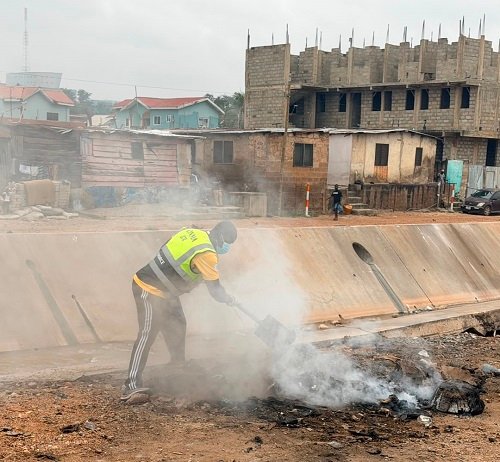
Instead of properly disposing of the waste collected, many households, workshops and neighbourhoods resorted to burning it.
Thick plumes of smoke rose into the sky from several communities during the clean-up. Even though many Metropolitan and Municipal Assemblies had deployed trucks and designated collection points to evacuate waste, numerous residents chose to burn piles of refuse within their compounds and open spaces.
The smoke lingered in the air for hours, creating an unhealthy atmosphere for children, the elderly and everyone exposed to it.
Some residents defended the practice, arguing that waste collection services remain inadequate and that the limited number of designated collection points is insufficient to cope with the volume of refuse generated daily. Burning of refuse was also observed beyond the cleanup exercise, suggesting that it remains a common waste disposal practice in some communities.
Their explanation points to a much bigger challenge confronting the country.
According to the Managing Director of the Landfills Company Limited, Dr Peter Kwesi Dagadu, Greater Accra, which produces thousands of tonnes of waste every day, has struggled for years with limited landfill capacity, and currently relies heavily on the landfill at Kpone which has reportedly reached or exceeded its intended capacity, while the Adepa Landfill in the Eastern Region increasingly receives waste transported from parts of the capital, placing enormous pressure on existing disposal infrastructure.
The situation has encouraged illegal dumping in several locations.
One example is the wetland around Mallam Junction, where refuse is reportedly dumped indiscriminately by residents and some tricycle operators engaged in waste collection.
What was once a natural wetland has gradually become an illegal dumpsite characterised by offensive odour, swarms of houseflies and polluted surroundings that pose serious health risks to nearby residents.
Improper waste disposal does not only pollute the environment. It also blocks drains, contributes to flooding and creates breeding grounds for disease carrying insects.
The World Health Organisation (WHO) warns that poor waste collection and unsafe disposal methods, including open burning, contaminate air, soil and water while increasing the risk of diseases in surrounding communities.
The health implications of burning refuse are equally worrying.
According to the WHO, open waste burning releases harmful pollutants that can cause coughing, skin irritation, respiratory diseases and other adverse health effects. The organisation identifies open burning as a significant source of air pollution and recommends stronger waste management systems to eliminate the practice.
Indeed, a WHO assessment on solid waste management in Accra found that eliminating open burning could significantly reduce harmful emissions and help prevent premature deaths associated with air pollution.
The success of the National Clean up Exercise therefore cannot be measured only by the number of drains cleared or tonnes of refuse collected.
It must also be measured by what happens after the brooms have been put away.
Government deserves commendation for initiating a nationwide exercise that rekindled civic responsibility and reminded citizens that environmental sanitation is a shared obligation. Likewise, Ghanaians deserve praise for embracing the initiative and demonstrating that collective action remains possible.
Yet sustaining those gains will require more than periodic clean up campaigns.
There is an urgent need to expand engineered landfill facilities, establish more transfer stations, strengthen recycling and composting programmes, improve waste collection services and strictly enforce regulations against illegal dumping and open burning.
Otherwise, Ghana risks replacing one environmental hazard with another.
A city free from refuse but filled with smoke cannot be considered truly clean. Protecting the drains from plastic waste is important, but protecting the air that every Ghanaian breathes is equally essential.
If the National Clean up Exercise is to leave a lasting legacy, it must inspire not only cleaner streets but cleaner air and a more sustainable waste management system for generations to come.
BY STEPHANIE BIRIKORANG