Particle pollution and health risks
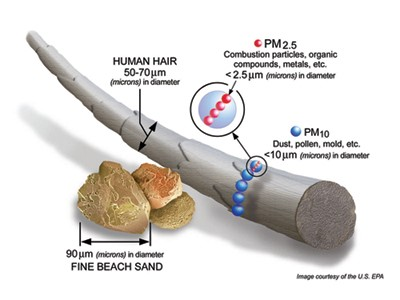
Particle pollution, also known as particulate matter or PM, is a general term for a mixture of solid and liquid droplets suspended in the air. Particle pollution comes in many sizes and shapes and can be made up of a number of different components, including acids (such as sulfuric acid), inorganic compounds (such as ammonium sulfate, ammonium nitrate, and sodium chloride), organic chemicals, soot, metals, soil or dust particles, and biological materials (such as pollen and mold spores). The air we breathe indoors and outdoors always contains particle pollution. Some particles, such as dust, dirt, soot, or smoke, are large enough to be seen with the naked eye. Others are so small they can only be detected using an electron microscope
Coarse and fine particles
Particles of concern can be grouped into two main categories:
Coarse particles (also known as PM10-2.5): particles with diameters generally larger than 2.5 µm and smaller than, or equal to, 10 µm in diameter.

Fine particles (also known as PM2.5): particles generally 2.5 µm in diameter or smaller. This group of particles also encompasses ultrafine and nanoparticles which are generally classified as having diameters less than 0.1 µm. Note that PM10 is a term that encompasses coarse, fine and ultrafine particle fractions.
Primary and secondary particles
Some particles, known as primary particles, are emitted directly from a source, such as construction sites, unpaved roads, smokestacks or fires. Other particles, known as secondary particles, form in complicated atmospheric reactions involving chemicals such as sulfur dioxides and nitrogen oxides that are emitted from power plants, industries and automobiles.
Cooking, smoking, dusting, and vacuuming can also produce particle pollution, particularly in indoor settings. Particles produced by combustion are more likely to be fine particles, while particles of crustal (earth) and biological origin are more likely to be coarse particles.
Particle pollution is found everywhere – not just in haze, smoke, and dust, but also in air that looks clean. Particle pollution can occur year-round and presents air quality problems at concentrations found in many places. Some particles can remain in the atmosphere for days to weeks. Consequently, particle pollution generated in one area can travel hundreds or thousands of miles and influence the air quality of regions far from the original source.
Particle pollution levels can be especially high in the following circumstances: near busy roads; in urban areas (especially during rush hour); in industrial areas; when there is smoke in the air from wood stoves, fireplaces, campfires, or wildfires; when the weather is calm, allowing air pollution to build up, e.g. hot humid days with stagnant air have much higher particle concentrations than days with air partially “scrubbed” by rain.
Because of their small size, fine particles outdoors can penetrate into homes and buildings. Therefore, high outdoor particle pollution levels can elevate indoor particle pollution concentrations. (USA-EPA sourced from website 25/09/26).
Mechanical and chemical processes
Particle pollution forms through two separate processes- mechanical and chemical. Mechanical processes break down bigger particles into smaller bits with the material remaining essentially the same, only becoming smaller in size. Dust storms, construction and demolition, mining operations, and agriculture are among the activities that produce such particles. Road wear of tires, brake pads and other vehicle components can also create particles.
Chemical processes in the atmosphere create most of the fine and ultrafine particles in the air. Particle pollutants such as elemental carbon (soot), volatile organic carbon compounds, heavy metals, and ammonia are released through chemical reactions such as burning fuels. Human activities and natural sources also emit gases that react in the air with other gases to form particles, such as when nitrogen dioxide and sulfur dioxide pollutants react with oxygen and water vapour in the air to form nitrate and sulfate particles.
Health effects of coarse and fine particles
The differences in size make a big difference in how particles affect us. Our natural defenses help us to cough or sneeze some coarse particles out of our bodies. However, the defenses do not keep out smaller fine or ultrafine particles. Fine particles can penetrate deep into the lungs, while some ultrafine particles and particle components may cross into the circulation, contributing to effects beyond the respiratory system. (American Lung Association website 25/09/26).
Evidence indicates that adverse health effects can occur even at relatively low concentrations of PM2.5, and risk generally increases as exposure increases. A recent review of available evidence shows that fine particle pollution is associated with increased risks of respiratory, cardiovascular, metabolic, auto-immune, neurological diseases and cancers (Sangkham, S. (2024). An update on adverse health effects from exposure to PM2.5. Environmental Advances, 100121.doi.org).
Vulnerable groups
The most vulnerable groups are those living close to the source of the emission. Others include pregnant individuals; infants, children, and teens; older adults (˃65 years of age); people with lung disease, such as asthma and chronic obstructive pulmonary disease); people with cardiovascular disease; people who are obese or have diabetes; current or former smokers; people with lung cancer; people with low socioeconomic status; and people of colour.
Particle pollution includes: PM10 : inhalable particles, with diameters that are generally 10 micrometers and smaller; and PM2.5 : fine inhalable particles, with diameters that are generally 2.5 micrometers and smaller. For perspective, a particle 10 µm in diameter is roughly 5–7 times smaller than the diameter of a typical human hair, while a 2.5 µm particle is roughly 20–30 times smaller. Even though both PM10 and PM2.5 can both enter the lungs PM2.5 (fine particles) poses the greatest health risk. Fine particles are also the main cause of reduced visibility (haze).
Air quality index
You can use air quality alerts to protect yourself and others when PM reaches harmful levels.Apps on your phone can be used to check the air quality daily, e.g. AirNow: Every day the Air Quality Index (AQI) tells you how clean or polluted your outdoor air is, along with associated health effects that may be of concern. The AQI translates air quality data into numbers and colors that help people understand when to take action to protect their health. If you live in a polluted area e.g. high vehicle traffic, on-going road construction, unpaved roads, then one should expect the air quality to be affected and therefore the need to wear the appropriate protective masks.
It is important to note that long-term exposure to fine particles in Air Pollution also increases the risks of developing chronic diseases such as hypertension, ischaemic heart disease, type 2 diabetes mellitus and cancers. In Ghana, particle pollution is particularly relevant in rapidly growing urban areas where heavy vehicular traffic, road construction, unpaved roads, open burning, industrial activities, generators and dust can contribute to poor air quality. This means particle pollution is not a distant environmental problem—it is an everyday public-health concern.”
Always remember to avoid tobacco smoking or second-hand smoke, improve indoor ventilation, avoid areas of high pollution, when exposure cannot be avoided, an appropriately fitted particulate respirator, such as an N95 or equivalent, may help reduce inhalation of fine particles.
Particle pollution may be invisible, but its effects on health can be significant. Cleaner air is therefore not merely an environmental issue—it is a public-health necessity. Individuals can reduce their exposure, but lasting protection also requires cleaner transport, better control of industrial and construction emissions, reduced open burning and effective air-quality management. The air we breathe matters to everyone.
DR EDWARD O. AMPORFUL
Former Chief Pharmacist of Cocoa Clinic.
You can now read the *Ghanaian Times* and *The Spectator* newspapers digitally on [TimesNewsPlus](https://timesnewsplus.com/newspapers).
Follow our WhatsApp Channel now! https://whatsapp.com/channel/0029VbAjG7g3gvWajUAEX12Q