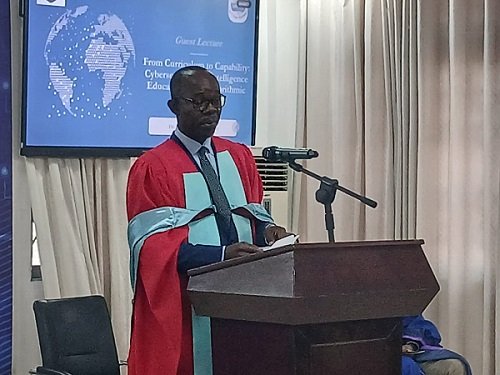
The Former Director-General of the Cyber Security Authority (CSA), Dr Albert Antwi-Boasiako, has called for a redesign of Ghana’s educational system to equip graduates with the ability to critically and ethically interrogate digital information in what he describes as the “algorithmic era.”
He explained that while algorithms, which are sets of rules, instructions, and mathematical models executed by computers, in decision-making processes, were powerful, such systems could negatively affect human lives and pose cyber security risks if left unquestioned.
He stated this during a public lecture delivered at the launch of two postgraduate programmes, Master of Science (MSc) in Cybersecurity and Digital Forensics, and MSc in Security and Intelligence, by Accra Metropolitan University in collaboration with the e-Crime Bureau in Accra on Wednesday.
The lecture, which was under the theme: ‘From Curriculum to Capability: Cybersecurity and Intelligence Education in the Algorithmic Era,’ emphasised the evolving role of human intelligence alongside machine-driven systems.


Dr Antwi-Boasiako, who is also the founder and Executive Chair of the e-Crime Bureau, further noted that algorithms were not neutral, as they were “designed by humans, trained on biased data and shaped by invisible assumptions.”
“We are in the algorithmic era in which human judgement increasingly competes with, collaborates with, and is sometimes replaced by algorithmic logic,” Dr Antwi-Boasiako indicated.
“This era raises a philosophical question that sits at the heart of higher education. If machines can know, what must humans become? Cybersecurity and intelligence education must now answer this critical question,” he added.
Dr Antwi-Boasiako stressed that “education in this context must go beyond the mere transfer of information,” noting that, “Education, therefore, in the context of the algorithmic era is not the transfer of information. It is rather the formation of a disciplined judgement.”
Dr Antwi-Boasiako underscored the need for Ghana’s education system to produce graduates capable of applying knowledge to address emerging digital and cybersecurity challenges.
He cautioned against overreliance on automated systems, stating that, “The greatest risk in the algorithmic era is not that, machines will become too intelligent. The real tragedy for the human condition is that humans will become passive, uncritical and heavily dependent on algorithms.”
Dr Antwi-Boasiako urged stakeholders, including educators, government, and industry players, to actively support the development of cybersecurity talent through deliberate workforce strategies, policy direction, and opportunities such as internships and work placements.
In her welcome address, Acting Vice Chancellor of Accra Metropolitan University, Professor Goski B. Alabi, said the newly launched postgraduate programmes would help tackle vulnerabilities in organisational systems.
She also announced plans to introduce a national hackathon by the end of the year, in partnership with the e-Crime Bureau, to give students a platform to develop innovative solutions to real-world security challenges.
The Director General of the National Patrol Department of the Ghana Police Service, Commissioner of Police (COP) Alhaji Mohammed Fuseini Suraji, highlighted the importance of collaboration between academia and security agencies in combating cybercrime.
BENJAMIN ARCTON-TETTEY & PERPETUAL MENSAH
Follow our WhatsApp Channel now! https://whatsapp.com/channel/0029VbAjG7g3gvWajUAEX12Q