Ritual in the Street: Spectacle, Surface, and the Theatrics of Becoming in Mavic Chijioke Okeugo’s Chale Wote Photograph
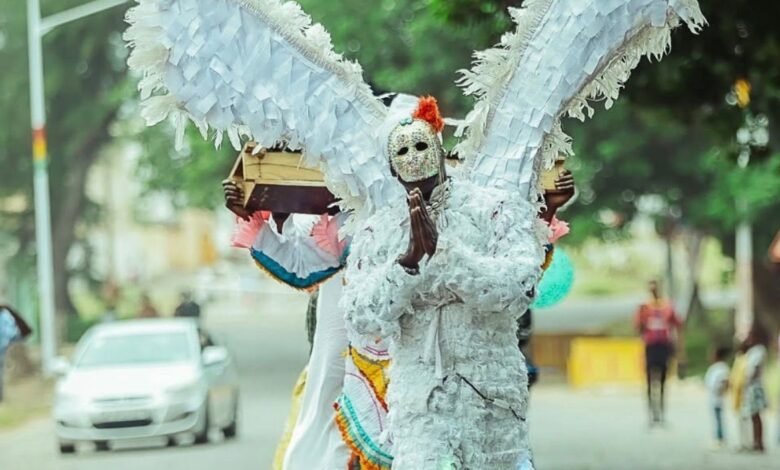
Photo shoot by Magic Chijioke in Ghana during Chale Wote 2025
In this photograph from the Chale Wote Street Art Festival in Ghana (August 19–25, 2025), Mavic Chijioke Okeugo turns his lens toward a figure suspended between masquerade, ritual, and urban procession. What we encounter is not merely documentation of a festival moment, but a carefully orchestrated visual drama in which costume, movement, and theatre makes the street a stage.
At the centre of the frame stands a winged figure, clad in white feathered, textured, luminous arms pressed together in a gesture that suggests prayer, greeting, or containment. The wings stretch outward, asserting a horizontal axis that counters the vertical thrust of the body. This cruciform geometry anchors the composition, transforming the figure into an icon. Okeugo’s framing is frontal and symmetrical enough to confer a monument on the image, and open enough to allow the surrounding street life to breathe at the edges.
The street here transcends backdrop, becoming the platform that carries the show. Receding cars, blurred pedestrians, and overhanging trees establish a depth of field that pushes the masquerader forward into dominance. The city is an audience. Unlike the controlled abstraction of studio portraiture, this is an image alive with contingency, movement caught mid-flow, the festival’s chaos disciplined into pictorial order.
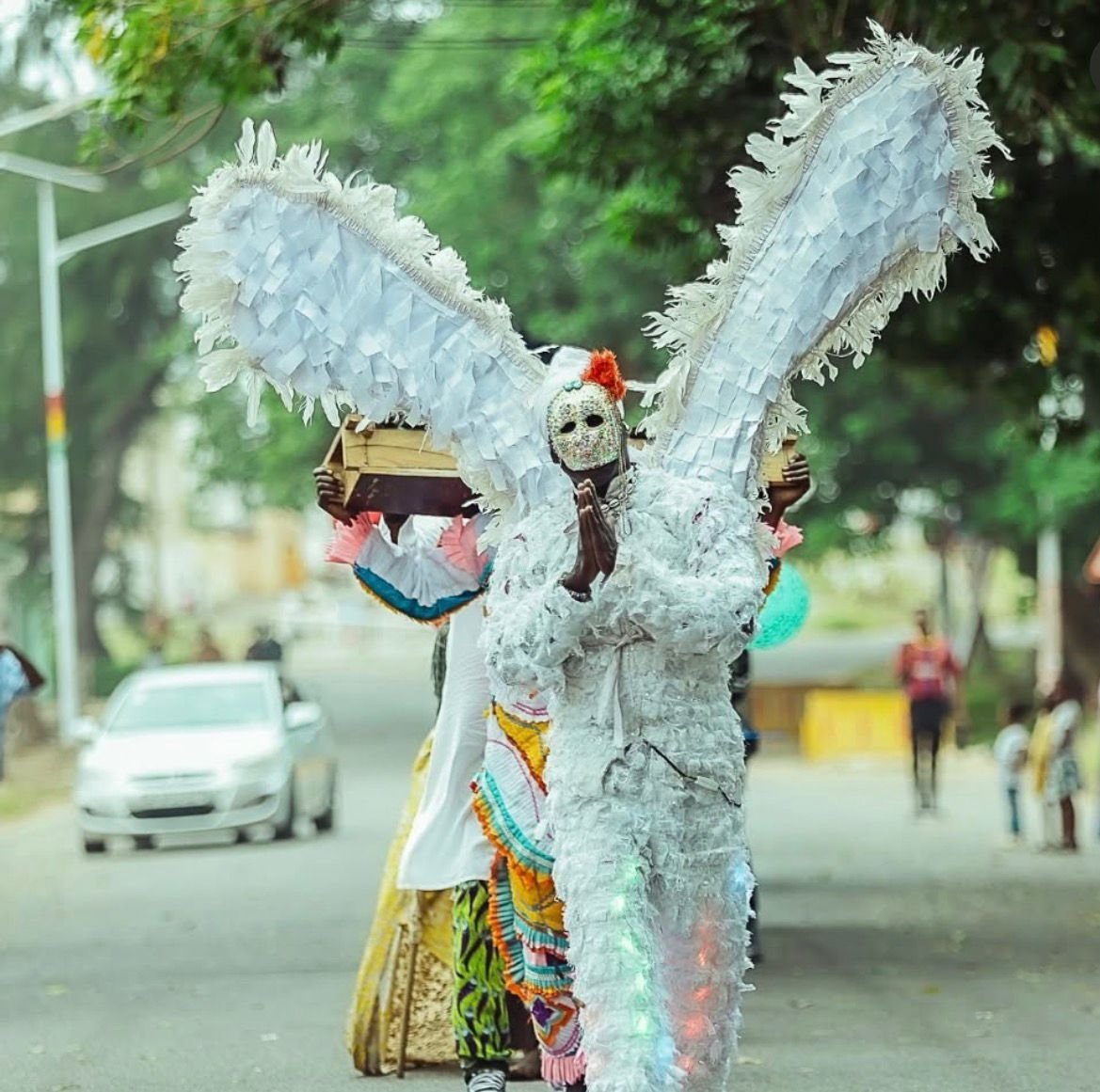
The colours are subtle but decisive. The whiteness of the costume, almost spectral cuts sharply against the blurred greens and greys of the urban environment. White here is not neutral; it is theatrical, performative, and symbolic. It absorbs light, making the figure glow with an otherworldly presence. The faint embedded lights along the costume introduce a modern, almost electronic shimmer, fusing ritual aesthetics with contemporary spectacle. Okeugo allows this glow to function as a visual pulse, a reminder that this “angel” belongs not to heaven but to the kinetic energy of the street.
Behind the central figure, layers of textile and color from hidden performers make an appearance; yellows, reds and patterned fabrics suggesting a procession, a community of bodies in motion. Yet they remain partially obscured, subordinated to the frontal authority of the winged form. This creates a hierarchy of visibility: one body crystallized, others dissolving into rhythm. The photograph thus stages an interplay between singular presence and collective identity, an echo of festival culture itself, where individuality asserts itself within communal flow.
Okeugo’s use of a shallow depth of field is critical. The background softens into blur, denying narrative specificity. We do not read signs, faces, or destinations; instead, the environment recedes into the atmosphere. This pushes the image toward allegory rather than documentary. The street becomes less Accra or Jamestown but a symbolic corridor, an in-between space where transformation happens.
The credit of the images’ conceptual weight is the tension between ritual and improvisation. The figure evokes masquerade traditions across West Africa, where costumed bodies mediate between worlds the living and the ancestral, the seen and unseen. Yet this is unmistakably a contemporary performance: crafted materials, LED-like lights, and the setting of a street art festival frame the masquerade as urban re-invention rather than inherited rite. Okeugo does not romanticize tradition; he shows it being re-scripted in real time.
As fine art photography, the work resists the temptation of ethnography. Okeugo’s interest is less in explaining the festival than in isolating a moment where form, gesture, and environment align into visual coherence. The praying hands become a formal knot at the centre of the image, drawing the eye inward before releasing it along the wings and down the body. The photograph holds because its internal rhythms, vertical body, horizontal wings, receding street are in balance.
There is also an undercurrent of ambiguity. The masked face is unreadable. We cannot access emotion, identity, or intention. This opacity is powerful: it keeps the image from collapsing into portraiture. Instead, the figure becomes a sign, of spirit, of performance, and becoming. In this way, Okeugo aligns with a broader contemporary African photographic tendency: to use staged or found performances as vehicles for questioning visibility, presence, and self-fashioning in public space.
Within the context of Chale Wote, a festival known for collapsing boundaries between art, life, and protest, the photograph functions as a distilled emblem of that ethos. It captures not noise but poise; not excess but suspension. The street pauses, if only for a fraction of a second, to allow this apparition to exist fully in the frame.
Ultimately, Okeugo’s image succeeds because it transforms a fleeting festival moment into a formal and symbolic encounter. It is not just about what happened on that street in Ghana, but about how the street itself can become a site of ritual, theatre, and visual reordering. The photograph bears witness to a body that claims space, commands attention, and reimagines the everyday as a zone of art. In this work, Mavic Chijioke Okeugo demonstrates that fine art photography, even in the midst of street chaos, can carve out moments of sculptural clarity where movement becomes monument, and the festival becomes form.
By Steve Ayorinde