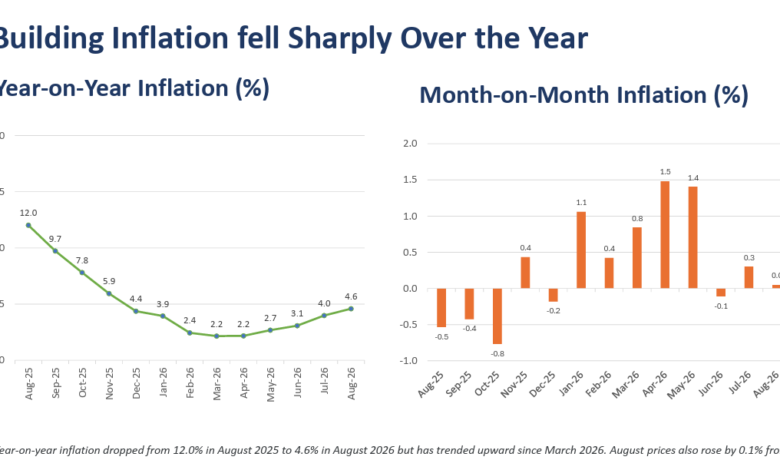
Ghana’s year-on-year building cost inflation inched up to 4.6 per cent in August from 4.0 per cent in July, the Ghana Statistical Service (GSS) has announced.
The increase was largely driven by materials, which dominate the Prime Building Cost Index and Inflation (PBCI), and recorded a year-on-year inflation rate of 5.8 per cent in August.
The Government Statistician, Dr Alhassan Iddrisu, who announced this on Tuesday when he presented the August 2026 PBCI in Accra on Tuesday, said on a month-on-month basis, building costs rose marginally by 0.1 per cent between July and August.
Despite the uptick in the annual rate, Dr Iddrisu said building cost inflation remained relatively low, with the latest figures showing significant differences in price movements across construction inputs.


“Building inflation remains low, despite the increase in the year-on-year PBCI in August 2026,” he said, while drawing attention to plant and equipment costs as an area requiring close monitoring.
He said the PBCI stood at 138.4 in August, compared with 132.3 in August 2025.
The Government Statistician said, materials, which account for 76.5 per cent of the PBCI basket, remained the dominant force behind the increase, recording inflation of 5.8 per cent, up from 5.1 per cent in July.
According to the GSS Boss, materials accounted for 96.5 per cent of the upward contribution to the headline rate.
Plant costs, although representing only four per cent of the basket, he said continued to record a much higher inflation rate of 17.9 per cent, stressing that that was slightly lower than the 18.0 per cent recorded in July, but the category still contributed 15.6 per cent to the overall inflation rate.
Labour, on the other hand, Dr Iddrisu said provided some relief to builders and contractors, with inflation remaining negative at -2.9 per cent, compared with -3.2 per cent in July. Labour accounted for a negative 12.1 per cent contribution to headline inflation.
“Plumbing recorded the highest year-on-year increase at 26.1 per cent, followed by reinforcement at 24.2 per cent, small tools at 23.4 per cent, roofing sheets at 21.7 per cent and glazing at 20.4 per cent,” the Government Statistician, said.
Dr Iddrisu said some key construction inputs became cheaper over the period as steel prices fell by 8.9 per cent, cement by 7.1 per cent and fine aggregate by 5.1 per cent, and unskilled labour and skilled labour also declined by 4.6 per cent and 1.8 per cent, respectively.
The GSS said electrical works, metalwork, glazing, plumbing and tiles were among the biggest upward contributors to the August headline rate, accounting for 44.1 per cent, 25.0 per cent, 22.9 per cent, 19.5 per cent and 13.9 per cent, respectively.
The PBCI tracks monthly price movements for 406 construction items, covering materials, labour and plant or equipment. Prices are collected from 489 outlets across 16 markets, with the index based on 2023 prices.
Overall, the August data suggest that building costs are rising at a relatively modest pace, although pressure in selected construction inputs continues to require attention.
BY KINGSLEY ASARE
You can now read the *Ghanaian Times* and *The Spectator* newspapers digitally on [TimesNewsPlus](https://timesnewsplus.com/newspapers).
Follow our WhatsApp Channel now! https://whatsapp.com/channel/0029VbAjG7g3gvWajUAEX12Q