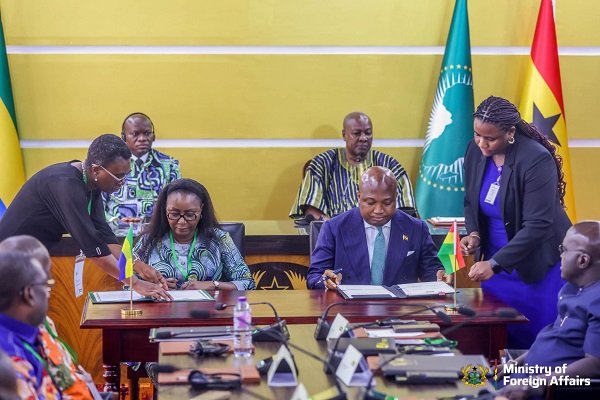
GHANA and Gabon have decried xenophobia, underscoring the need for Africans to collectively shun and decisively address the menace and all forms of discrimination.
The two countries argued that xenophobia threatened the cohesion and shared progress of the continent and affects the objectives of the African Union’s Agenda 2063.
The two countries made the call in a communique issued and signed by their respective Ministers of Foreign Affairs, Samuel Okudzeto Ablakwa and Marie-Edith Tassyla-Ye-Doumbenen after a bilateral meeting between President John Dramani Mahama and his Gabonese counterpart, Brice Clotaire Oligui Nguema, at the Presidency in Accra on Tuesday.
Mr Nguema is on a three-day state visit to Ghana at the invitation of President Mahama as both countries seek to further strengthen bilateral relations between them.

The call by the two countries comes on the back of renewed xenophobic attacks on black migrants in South Africa leading to, in some cases, deaths. Ghana has confirmed the death of two citizens since the renewed wave in April.
“The two leaders reiterated their commitment to maintaining close consultation and coordination within the African Union, the United Nations, the African Continental Free Trade Area framework, and other multilateral fora on issues of common interest, with the aim of advancing Africa’s collective interests,” the communique presented by Mr Ablakwa read in part.
According to the communique, the two leaders reaffirmed their collective commitment for African action to promote peace, sustainable development and shared prosperity towards Agenda 2063; a strategic master plan for inclusive growth, sustainable development, and political unity.
The presidents, the communique said, exchanged views on regional, continental and international developments, reaffirmed their commitment to the purposes and principles of the Constitutive Act of the African Union and the United Nations Charter, and pledged to continue working together to promote peace, security, constitutional governance, democracy, the rule of law and sustainable development on the African continent.
“The two leaders reiterated their commitment to maintaining close consultation and coordination within the African Union, the United Nations, the African Continental Free Trade Area framework, and other multilateral fora on issues of common interest, with the aim of advancing Africa’s collective interests,” the communique added.
As part of the bilaterals, the two Heads of State identified priority areas like trade and economic cooperation, mining and mineral value addition, oil, gas and energy, agriculture and agribusiness, fisheries and aquaculture, for enhanced bilateral cooperation.
Other bilateral cooperation entered into are forestry, biodiversity conservation and climate change, maritime affairs and the blue economy, education and human capital development, digital transformation and public sector modernisation, health cooperation, tourism and cultural cooperation, and defense and security cooperation.
BY JULIUS YAO PETETSI
Follow our WhatsApp Channel now! https://whatsapp.com/channel/0029VbAjG7g3gvWajUAEX12Q