Ghana TVET Service, DTI sign strategic partnership to employability, workforce competitiveness
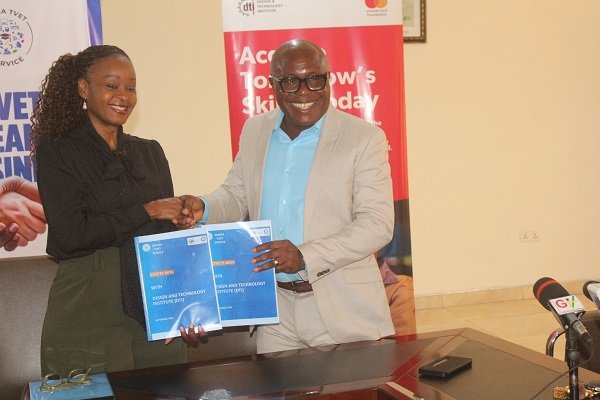
The Ghana TVET Service (GTVETS) and the Design & Technology Institute (DTI) have signed a Memorandum of Understanding (MoU) to establish a strategic Public–Private Partnership to strengthen Technical and Vocational Education and Training (TVET), deepen industry participation in skills development, and improve employment and entrepreneurship outcomes for young people in Ghana.
The partnership brings together the national reach of Ghana TVET Service and DTI’s expertise in industry-led skills development, institutional strengthening and workforce preparation to build a more responsive, quality-driven and industry-aligned TVET ecosystem supporting Ghana’s industrialisation and human capital development agenda.
The agreement provides a framework for collaboration in institutional strengthening, trainer and leadership development, Workplace Experience Learning (WEL), apprenticeship and dual TVET systems, industry engagement, digital transformation, quality assurance, research, monitoring and evaluation, and transition-to-work support.
The Director-General of the Ghana TVET Service, Professor Ernest Kofi Davis Adzroe, described the partnership as a purposeful collaboration to support Government’s efforts to equip young people with relevant and employable skills.

He said Ghana TVET Service, established under Act 1049 to implement pre-tertiary TVET policies and programmes, currently “oversees about 261 TVET institutions across the country.”
Prof. Adzroe observed that many graduates remained unemployed years after completing their education because they lacked practical skills demanded by industry.
He said the partnership would initially focus on strengthening the capacity of teachers and facilitators to remain abreast of changing technologies and industry practices.
“The world is changing rapidly in technology, ideas and every aspect of human existence. We need to work with institutions such as DTI that are at the forefront of advanced skills development,” he said.
The Founder and President of DTI, Ms Constance Swaniker,said the partnership reflected a shared commitment to strengthening the institutions and systems required to support Ghana’s industrialisation, productivity and employment ambitions.
She identified gaps in trainer competencies, workplace exposure, industry linkages, skills data systems and utilisation of training equipment as areas requiring sustained attention.
“These are not failures of intention but realities of a system being asked to do more, move faster and serve more young people than ever before,” she said.
Ms Swaniker said DTI, a Pan-African not-for-profit TVET Centre of Excellence, was established to demonstrate that African institutions could deliver training to globally competitive standards.
Through its partnership with the Mastercard Foundation, DTI has trained more than 40,000 young people and master craftsmen since 2020, including about 15,000 persons from the informal sector. This year, 4,760 master craftsmen and small business owners graduated from DTI’s Precision Quality programmes in Accra, Kumasi, Takoradi and Tamale.
She said DTI’s programmes are benchmarked against international standards and accredited by organisations including the American Welding Society, the National Occupational Competency Testing Institute (NOCTI) of the United States, and Pearson.
Ms Swaniker also highlighted DTI’s Precision Quality™ methodology, which combines technical competence with workplace values such as accountability, safety consciousness, teamwork, professionalism and continuous improvement.
Under the partnership, she said Ghana TVET Service and DTI would undertake institutional assessments and use the findings to strengthen training delivery, trainer and leadership capacity, institutional systems and the effective utilisation of infrastructure and equipment.
“A major focus will be on bringing industry closer to TVET through stronger Workplace Experience Learning, Industry Liaison functions, apprenticeship and dual TVET models, employer partnerships and industry participation in training. The collaboration will also strengthen pathways from training into wage employment, self-employment andentrepreneurship, supported by improved graduate and employment tracking,” Ms Swaniker stated.
BY KINGSLEY ASARE
You can now read the *Ghanaian Times* and *The Spectator* newspapers digitally on [TimesNewsPlus](https://timesnewsplus.com/newspapers).
Follow our WhatsApp Channel now! https://whatsapp.com/channel/0029VbAjG7g3gvWajUAEX12Q