Ghana’s oil output decline: Natural maturity or investment deficit?
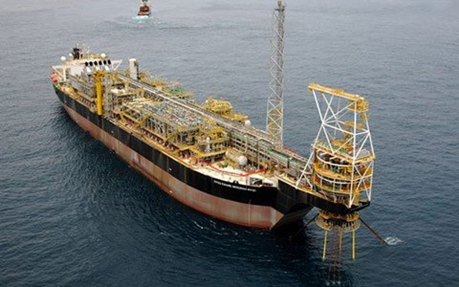
More than a decade after Ghana joined the ranks of oil-producing nations, the country’s upstream petroleum industry is facing a defining question: Is the steady decline in crude oil production the inevitable result of ageing oil fields, or has it been accelerated by years of underinvestment and slowing exploration?
The issue has assumed greater significance as petroleum revenues continue to underpin public finances, infrastructure spending and economic planning. According to the Public Interest Accountability Committee (PIAC), the cumulative oil revenues from 2011 to 2025 amounted to US$11.97 billion.
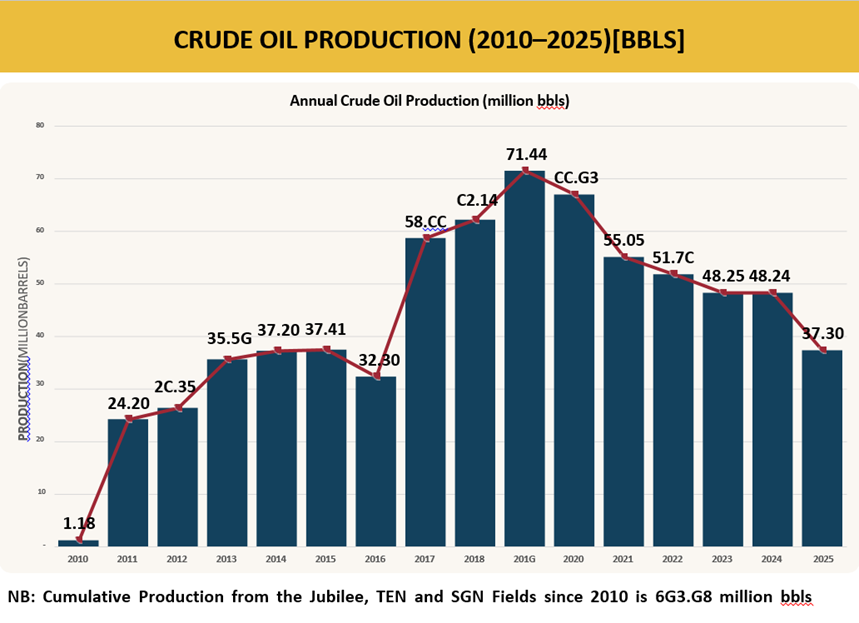
Data from PIAC show that Ghana’s crude oil production declined for the sixth consecutive year in 2025. Output fell from a peak of 71.44 million barrels in 2019 to 37.3 million barrels in 2025, representing a compound annual average decline of about nine per cent.
The trend has intensified debate within the industry over whether Ghana’s existing fields have entered a mature phase or whether production could have been sustained through greater investment in exploration, appraisal and field development.
The discussion has been sharpened by developments in Guyana, one of the world’s newest oil producers. Since commencing commercial production in 2019, the Caribbean country has rapidly expanded output, producing 261.1 million barrels in 2025 after increasing daily production from about 120,000 barrels in 2021 to approximately 716,000 barrels in 2025, according to OilNow.
The comparison is particularly striking because Ghana’s Tano Basin, including the Jubilee Field, and Guyana’s Stabroek Block share similar geological origins. Industry experts frequently describe them as “Atlantic mirrors,” having formed from the same geological structures before the separation of Africa and South America millions of years ago. Both contain deep-water sandstone reservoirs located far offshore, making Guyana’s performance a useful benchmark in discussions about Ghana’s production outlook.
The anatomy of declining production
Commercial oil production in Ghana began in 2010 with the Jubilee Field. After about 15 years of production, some analysts argue that the country’s major offshore assets are naturally entering a mature phase.
Industry experts note that oil fields generally produce at their highest levels during their early years before output gradually declines as reservoir pressure falls and commercially accessible reserves become depleted. As fields mature, producers often encounter higher water and gas cuts, making extraction more technically demanding and expensive.
These characteristics are common across mature petroleum provinces. However, analysts caution that declining production is not solely determined by geology. In many producing countries, sustained investment in drilling, enhanced oil recovery technologies, infrastructure upgrades and new discoveries has extended the productive lives of ageing fields and moderated production declines.
For Ghana, therefore, the debate extends beyond reservoir maturity to whether sufficient investment has been made to replenish reserves and sustain production.
Is the decline natural?
Some industry players acknowledge that lower production from mature fields such as Jubilee is expected after more than a decade of commercial operations. However, others contend that the pace of the decline reflects broader investment challenges rather than geology alone.
The Chief Executive Officer of African Energy Consortium Limited, Dr. Kwame Jantuah, argues that inadequate exploration and an uncertain investment environment have significantly contributed to Ghana’s falling oil output.
“Lack of comprehensive exploration over the years has fuelled the decline in Ghana’s oil output,” he said. “We need to get the politics of our oil and gas industry right to attract the major international companies. No investor will commit billions of dollars to exploration if the investment environment exposes them to unnecessary political and regulatory risks.”
Dr Jantuah believes Ghana should complement efforts to attract international oil companies with stronger support for indigenous participation in the upstream sector.
“We must be intentional about supporting Ghanaian investors,” he said. “Going forward, we need to handhold local companies and create an environment that enables them to participate meaningfully in onshore exploration and production.”
He proposed that onshore petroleum operations be reserved for indigenous companies, arguing that they require significantly lower capital investment than offshore developments.
“Onshore operations do not require floating production storage and offloading vessels that cost billions of dollars,” he said. “What you need is a pump jack. Compared with offshore infrastructure, a pump jack is relatively affordable. This presents a realistic opportunity for capable Ghanaian companies to build expertise, create jobs and contribute meaningfully to the country’s petroleum industry.”
Investment concerns
In its 2025 Annual Report, PIAC urged the Petroleum Commission to develop a framework that would encourage investment in existing producing fields, particularly the Tweneboa-Enyenra-Ntomme (TEN) project. The Committee also recommended improving fiscal and regulatory arrangements, expanding geological data acquisition in emerging petroleum basins and implementing a medium-term investment plan to enhance reservoir interconnectivity within the TEN field.
According to PIAC, these measures could improve production performance, extend the productive life of existing assets and strengthen the long-term resilience of Ghana’s upstream petroleum industry.
Government has also signalled renewed efforts to revive production through fresh upstream investment. Speaking during the Citizen Engagement Programme under President John Dramani Mahama’s Resetting Ghana Agenda in May 2026, Minister for Energy and Green Transition, John Abdulai Jinapor, stated that government had secured major investment commitments to boost oil and gas production.
“Government has secured a US$1.5 billion agreement with ENI and a US$2 billion deal with Jubilee Partners to boost oil and gas production. These deals are aimed at strengthening Ghana’s upstream petroleum sector and improving overall production levels,” the Minister said.
Economic implications
The decline in Ghana’s crude oil production has implications that extend beyond the petroleum industry, affecting public finances, economic planning and the government’s capacity to fund strategic investments.
Lower output directly affects petroleum revenues that flow through the Petroleum Holding Fund before being allocated to the Ghana Stabilisation Fund (GSF), Ghana Heritage Fund (GHF) and the Annual Budget Funding Amount.
In 2025, allocations to the two sovereign wealth funds stood at US$160.5 million for the Ghana Stabilisation Fund and US$68.8 million for the Ghana Heritage Fund. A prolonged decline in production could reduce future inflows, limiting the funds’ ability to support economic stability and preserve petroleum wealth for future generations.
The impact could also be felt in government infrastructure programmes funded through petroleum revenues. In 2025, government ring-fenced US$434.55 million in oil revenues for the proposed Accra-Kumasi Expressway project. Continued production declines could reduce the resources available for such strategic investments and other priority programmes.
Economist Professor Godfred A. Bokpin in an interview said Ghana’s declining oil output has become a fiscal concern because petroleum revenues have fallen short of expectations.
“We are not getting sufficient tax revenue from the oil sector as we had envisaged, and that is a cause for concern,” he said.
However, he noted that increased upstream activity could improve the outlook if it results in higher production.
“We expect some corresponding increase in annual production going forward, which will strengthen tax revenues, boost inflows into the Heritage and Stabilisation Funds, and increase the Annual Budget Funding Amount,” Prof. Bokpin added.
Addressing the policy and investment measures Ghana should prioritise to withstand future economic shocks, the economist called for policies that attract new investment into the upstream petroleum sector.
He said changing global energy dynamics, including shifts in the pace of the energy transition, could create opportunities for Ghana to expand exploration and production.
“We need to attract the much-needed investment by pursuing investor-friendly policies. We need new oil blocks, whether we like it or not, because our economy is still unable to generate sufficient tax revenue,” he said.
Prof. Bokpin, however, stressed that petroleum resources must be managed strategically to reduce Ghana’s dependence on oil revenues.
“These are exhaustible natural resources, so the proceeds must be used to diversify the economy and build a stronger, more resilient tax base,” he added.
The future of Ghana’s petroleum sector
Despite declining output from existing fields, Ghana’s petroleum sector still holds significant potential if supported by timely investment, exploration and improved recovery strategies.
Industry analysts argue that sustaining production will require a balance between maximising value from existing assets and attracting investment into new opportunities. Enhanced oil recovery technologies, additional offshore exploration and stronger gas infrastructure could help slow production declines and extend the lifespan of producing fields.
The challenge for Ghana is navigating a changing global energy landscape. While international efforts to transition away from fossil fuels are reshaping investment decisions, petroleum revenues remain an important source of funding for economic development, public finances and infrastructure projects.
The experience of Guyana demonstrates that significant growth in oil production is possible when exploration activity, investment and favourable geological conditions align. For Ghana, however, the priority will be creating the conditions needed to attract capital while ensuring petroleum wealth contributes to broader economic transformation.
Whether Ghana’s declining oil production is primarily the result of natural field maturity or an investment deficit remains a subject of debate. What is increasingly clear is that reversing the trend will require a combination of policy certainty, sustained investment, exploration and effective management of petroleum revenues.
The writer is a journalist
By EDWARD ADJEI FRIMPONG
Follow our WhatsApp Channel now! https://whatsapp.com/channel/0029VbAjG7g3gvWajUAEX12Q