Building cost inflation rises to 4.0% in July – GSS
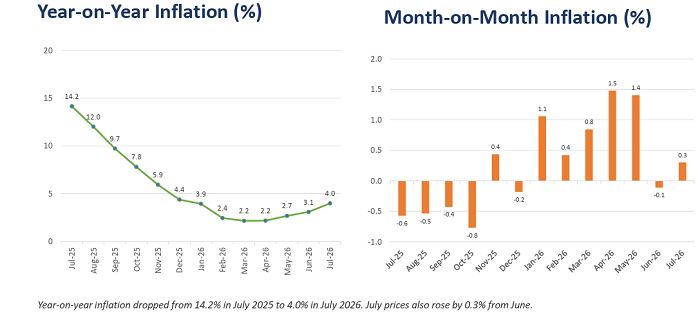
The year-on-year building cost inflation rose to 4.0 per cent in July 2026, from 3.1 per cent in June, the Ghana Statistical Service (GSS) has announced.
The latest figures show that while the cost of putting up buildings in the country remains relatively subdued compared with a year ago, pressure is beginning to build in some key areas, particularly plant and equipment, plumbing and other installation-related works.
The Prime Building Cost Index (PBCI) which measures changes in the overall cost of constructing buildings by tracking the prices of major inputs, including materials, labour and plant and equipment, increased from 137.9 in June to 138.3 in July, representing a monthly increase of 0.3 per cent.
The Government Statistician, Dr Alhassan Iddrisu, who released data on the July PBCI in Accra yesterday, said the figures reflected a broad moderation in construction cost pressures over the past year, although emerging increases in plant and selected building inputs required close monitoring.
According to the GSS, the July figure represents the percentage change in building costs between July 2025 and July 2026. Although the annual rate increased from June, it was significantly lower than the 14.2 per cent recorded in July 2025, pointing to a broad moderation in construction cost pressures over the past year.
Materials continued to have the greatest influence on the index, recording a year-on-year inflation rate of 5.1 per cent, up from 3.9 per cent in June. The group accounts for 76.5 per cent of the PBCI basket and contributed 97.3 per cent of the upward movement in the headline rate.
Plant, however, emerged as the major area of concern. Its inflation rate accelerated to 18.0 per cent, from 16.0 per cent in June, despite accounting for only four per cent of the basket.
Labour, on the other hand, helped to contain the overall increase, with inflation falling to -3.2 per cent, indicating that labour costs were lower than they were a year earlier.
At the sub-group level, plumbing recorded the highest inflation at 25.3 per cent, followed by small tools at 22.6 per cent, roofing sheets at 21.4 per cent, glazing at 20.4 per cent and reinforcement at 20.2 per cent.
In contrast, cement recorded the lowest inflation at -9.8 per cent, followed by steel at -8.9 per cent, unskilled labour at -5.2 per cent, fine aggregate at -5.0 per cent and skilled labour at -2.0 per cent.
Dr Iddrisu said the figures showed that building cost movements were becoming increasingly uneven, with some inputs providing relief while others continued to push project costs upwards.
For households and developers, the Service advised that the latest figures should encourage closer monitoring of supplier quotations and more realistic budgeting rather than assuming that all construction inputs were becoming more expensive.
For contractors and businesses, the emerging pressure from plant, tools and installation materials makes it important to factor current market conditions into contracts and procurement decisions.
The GSS also urged government to use the relatively lower inflation environment to improve project delivery, while paying particular attention to plant and installation costs. Read More
By KINGSLEY ASARE
You can now read the *Ghanaian Times* and *The Spectator* newspapers digitally on [TimesNewsPlus](https://timesnewsplus.com/newspapers).
Follow our WhatsApp Channel now! https://whatsapp.com/channel/0029VbAjG7g3gvWajUAEX12Q