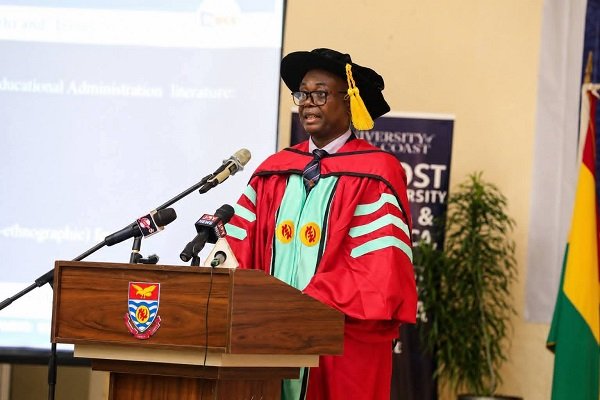
A Professor of Applied English Linguistics, Prof. Joseph Benjamin Archibald Afful, has called for a comprehensive review and redesign of foundational learning programmes in Ghanaian universities to ensure they meet contemporary global demands and remain relevant.
He explained that institutional foundation courses, such as the Communicative Skills programme at the University of Cape Coast (UCC) and similar programmes in other tertiary institutions, tended to focus largely on remediation.
According to him, this approach often created a gap between discipline-specific contexts and what was taught in the classroom.
Prof. Afful, therefore, advocated a shift away from remediation towards a more discipline-specific orientation, supported by technology-driven and critical-based pedagogy to address modern academic needs.


He made the call while delivering his inaugural lecture on the topic, “Tales of Two Cities: The Case of an Applied English Linguist.”
Reflecting on his academic journey, Prof. Afful observed that most scholars and students in Ghana were not native speakers of English, yet operated within a system where English remained the sole official language and medium of instruction.
He underscored the need for tertiary institutions to institutionalise specialised retraining for instructors of English for Academic Purposes (EAP) and postgraduate thesis supervisors.
This, he emphasised, would help align teaching and supervision with both local and global trends in English for Academic and Publishing Purposes (EAPP).
In addition, he urged universities and other stakeholders to provide internal funding and targeted training for junior faculty and doctoral students.
Such training, he noted, should focus on international publishing literacy, citation practices and genre conventions to enhance Ghana’s global academic visibility.
Prof. Afful also called for a review of the academic writing course for graduate students at UCC, particularly in relation to its objectives, pedagogy and instructional materials. He pointed out that the course had not been reviewed since its introduction in 2017.
He further encouraged other universities in the country to introduce structured postgraduate writing courses.
According to him, such programmes should incorporate models of English for academic and publishing purposes into their coursework.
He emphasised that implementing specialised English for publishing and graduate writing courses was essential to boosting the global visibility and research output of Ghanaian universities.
Beyond academia, Prof. Afful called on the Ministry of Local Government and Rural Development to strictly enforce guidelines governing the naming of public spaces, streets and institutions.
He noted that such practices should balance the preservation of national heritage with the demands of modern urban and global functions.
He explained that naming conventions and address practices played a significant role in shaping interpersonal interactions across the country, adding that a lack of understanding of these context-specific practices could lead to social friction and ineffective cross-cultural communication.
He said recognising informal markers and other address practices could help academic institutions and organisations improve workplace cohesion and employee motivation.
Prof. Afful further urged government agencies, civil society organisations and corporate institutions to develop communication policies that recognise and validate indigenous Ghanaian forms of address in order to promote cultural pride and mutual respect.
He again called on the Ministry of Tourism, Arts and Culture, as well as the National Commission on Culture, to establish frameworks to protect and promote local naming practices.
Such measures, he underlined, would help preserve understudied local languages and keep indigenous histories alive.
FROM DAVID O. YARBOI-TETTEH, CAPE COAST
Follow our WhatsApp Channel now! https://whatsapp.com/channel/0029VbAjG7g3gvWajUAEX12Q