Black Rock belongs to Nungua — Mankralo
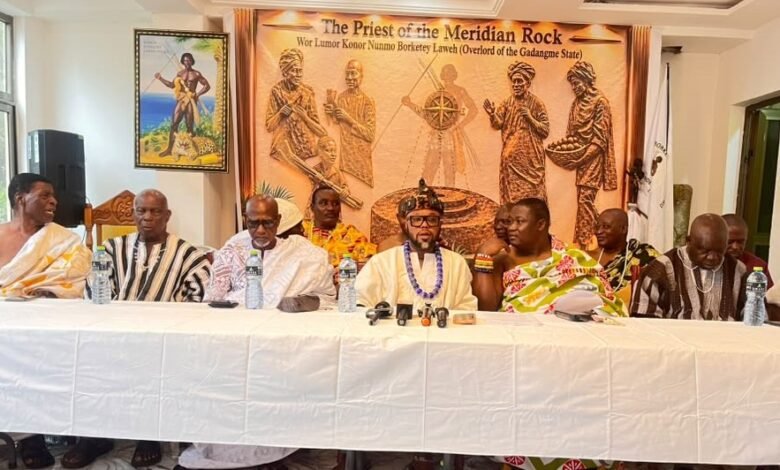
THE Office of the Nungua Mankralo has rebuffed claims by the Tema and Sanshie clans that the location of Angmu T3 (The Meridian Rock) falls under their authority.
According to the Mankralo, available records, court rulings and customary evidence all point to the fact that the site where the rock is located falls under the jurisdiction and authority of Nungua.
The claims follow a recent outburst by the Sanshie Clan of Tema that the Gborbu Wulomo had no right to perform customary rites around the rock because it falls directly under the authority of Tema.
However, at a press conference in Nungua on Tuesday, the Nungua Mankralo, Shwɔɔnɔtalɔ Tɛstɛ Nii Bortey Kofi Frankwa, said the Black Rock was among the 99 deities of Nungua Kple Spirituality.


He said the annual Djenten rite was an established Nungua tradition performed exclusively by the Gborbu Wulomo Shitse, the town’s spiritual head, whose customary responsibilities included conducting important sacred rites for the community’s deities.
The office cited Professor M.J. Field’s 1937 publication, Religion and Medicine of the Ga People, which it said associated all 99 Nungua deities with the Nuumo Gorbu Temple, known locally as Koomli, in Nungua tradition.
It also relied on Field’s Social Organisation of the Ga People, published in 1940 and widely cited, which identified the Gborbu Wulomo Shitse as the traditional timekeeper responsible for announcing the town’s rites and festivals.
Further evidence, it said, came from Carl Christian Reindorf’s 1895 publication, History of the Gold Coast and Asante, which identified Borkete Lawe as the priest of Angmu, supporting Nungua’s account of its spiritual custodianship and ritual authority.
The statement also cited a Bureau of Ghana Languages publication and a book by Dr Joseph Nii Abakar Mensah as documentary records affirming the Gborbu Wulomo Shitse’s association with Angmu and the annual Djenten rite.
It rejected claims that Angmu and Oshwe were the same deity, saying Angmu was known in Nungua Kple tradition as Sebrebedu, while Oshwe Yaado was a separate deity with distinct spiritual and customary responsibilities.
On the boundary dispute, the office cited an 1892 judgement by Chief Justice Hutchinson and a 1904 ruling by Crowther, which it said recognised Nungua’s right of access to Angmu, historically described as the Black Rock in the sea.
It argued that the 1952 compulsory acquisition for Tema Township and Port altered administrative arrangements but did not extinguish traditional boundaries or customary rights, stressing that administrative jurisdiction did not establish traditional ownership.
The office further disputed claims that Professor Field placed the Tema-Nungua boundary at Asokplotsonaa, saying page 87 of her book contained no such statement and instead discussed Ataa Sakumo’s historical connection with Nungua.
It also pointed to the 2016 Tema Port expansion, saying the Nungua Traditional Authority was consulted and its permission sought before work began, which it considered further recognition of Nungua’s traditional interest in the area.
BY NELLY QUARCOOPOME
SKIP THE QUEUE, TAP THE NEWS

Read the Ghanaian Times and The Spectator newspapers from the comfort of your device via TimesNewsPlus.
Follow our WhatsApp Channel now! https://whatsapp.com/channel/0029VbAjG7g3gvWajUAEX12Q