Economy strong despite global headwinds – Governor

The Bank of Ghana (BoG) has maintained its Monetary Policy Rate (MPR) at 14 per cent, citing resilient domestic economic activity and a broadly balanced outlook for inflation and growth.
The members of the Monetary Policy Committee (MPC) unanimously voted for the policy rate to be maintained at 14 per cent.
The Governor of the BoG and Chairman of the MPC, Dr Johnson Pandit Asiama, announced the decision yesterday at the 132nd Monetary Policy Committee of the BoG press conference, said the economy continued to demonstrate resilience despite heightened global uncertainty.
“The committee viewed the balance of risks to inflation and growth as broadly balanced, and the committee voted by a unanimous decision to maintain the Monetary Policy Rate at 14.0 per cent,” he said.


The MPR is the rate at which the central bank lends to commercial banks and serves as a key signal for interest rates and credit conditions in the economy.
Dr Asiama said global economic activity remained resilient during the first half of 2026, although geopolitical tensions, higher energy prices and supply chain disruptions continued to pose risks.
The International Monetary Fund (IMF) has maintained its 2026 global growth projection at three per cent. However, crude oil prices have risen to slightly above US$100 per barrel, while the possibility of adverse weather conditions could put additional pressure on food prices.
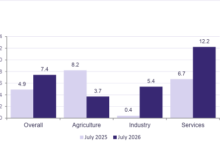
Domestically, the economy recorded real Gross Domestic Product (GDP) growth of six per cent in the second quarter of 2026, driven mainly by the services and industry sectors. This was, however, lower than the 6.6 per cent recorded in the corresponding period of 2025.
The Composite Index of Economic Activity (CIEA) also grew strongly by 14.9 per cent year-on-year in July, compared with 6.1 per cent a year earlier.
Inflation, meanwhile, increased marginally to five per cent in August, from 4.6 per cent in July, mainly due to higher non-food inflation following utility tariff adjustments and elevated crude oil prices.
Despite the increase, headline inflation remained below the lower bound of the BoG’s medium-term target band of eight per cent, plus or minus two percentage points.
The Governor said underlying inflationary pressures remained contained, with core inflation easing slightly to 4.2 per cent in August from 4.3 per cent in July.
Interest rates also continued to moderate. The 91-day Treasury bill rate declined to 5.4 per cent in August, from 10.3 per cent a year earlier, while the average bank lending rate fell to 15.9 per cent, from 24.2 per cent.
Private sector credit growth consequently rebounded strongly to 35.5 per cent, compared with 13.3 per cent in August 2025.
On the external front, the country’s trade surplus increased to $8.85 billion in the first eight months of 2026, from $6.69 billion over the same period last year.
Gross international reserves stood at $12 billion, equivalent to 4.5 months of import cover, as of September 22, 2026.
Dr Asiama said the Committee would continue to monitor developments closely, particularly global energy prices, exchange rate movements, utility tariffs and supply chain disruptions.
BY KINGSLEY ASARE
You can now read the *Ghanaian Times* and *The Spectator* newspapers digitally on [TimesNewsPlus](https://timesnewsplus.com/newspapers).
Follow our WhatsApp Channel now! https://whatsapp.com/channel/0029VbAjG7g3gvWajUAEX12Q