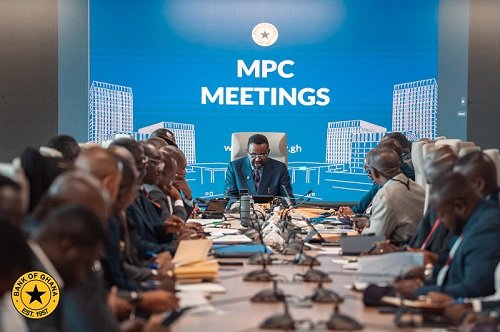
The Governor of the Bank of Ghana, Dr Johnson Pandit Asiama, has urged members of the Monetary Policy Committee (MPC) to take into account both domestic and global economic conditions in arriving at a policy decision that will sustain macroeconomic stability and support the country’s ongoing disinflation process.
He noted that the initial conditions of the Ghanaian economy had improved considerably due to sustained reforms undertaken in recent years, but cautioned that the worsening external environment required prudent and forward-looking policy responses.
Opening the 130th MPC meeting in Accra yesterday, Dr Asiama said although Ghana’s economy had shown significant improvement since the last meeting in March this year, rising global uncertainties, particularly the protracted conflict in the Middle East, posed fresh risks to inflation and economic stability.
“We are meeting at a moment of heightened policy complexity,” he stated, adding that the MPC over the next three days would deliberate on how to preserve the gains achieved so far while responding appropriately to emerging global and domestic risks.


Dr Asiama explained that the ongoing Middle East conflict and the closure of the Strait of Hormuz had triggered a sharp increase in global energy prices, with significant implications for commodity-importing economies such as Ghana.
According to him, the International Monetary Fund (IMF) had revised downward its 2026 global growth forecast from 3.3 per cent to 3.1 per cent due to the impact of the conflict on global demand and supply chains.
He said the surge in energy prices had already begun feeding into inflation in several advanced and emerging economies, forcing some central banks to halt or reverse planned monetary easing measures.
For Ghana, Dr Asiama said the transmission of the external shocks would be felt through higher fuel prices, transportation costs, import bills and consumer prices.
Touching on domestic developments, he disclosed that inflation had recorded its first increase since December 2024, signalling the need for vigilance despite the broader gains in macroeconomic stability.
He, however, indicated that the economy continued to demonstrate resilience, citing improved current account performance, renewed investor confidence in government securities and positive growth projections captured in the IMF’s April 2026 World Economic Outlook.
Among the positive indicators highlighted were the successful issuance of a seven-year government bond, the resumption of domestic treasury bond issuance and plans by government to raise one billion dollar through local currency bonds to finance cocoa purchases for the 2026/27 crop season.
Dr Asiama also mentioned measures announced by government to cushion consumers against rising petroleum prices through temporary reductions in regulatory margins on fuel products.
On Ghana’s engagement with the IMF, the Governor said discussions had advanced on a 36-month non-financing Policy Coordination Instrument (PCI) following the successful implementation of the Extended Credit Facility (ECF) programme.
He explained that the PCI would focus on sustaining fiscal discipline, safeguarding debt sustainability, strengthening monetary and exchange rate frameworks and reinforcing financial sector stability.
Dr Asiama said the proposed corridor reforms being discussed by the MPC were in line with the PCI’s objective of strengthening monetary policy transmission and anchoring inflation expectations.
He further stressed the need to maintain a strong and stable banking sector capable of supporting credit expansion and economic growth.
The Governor warned that risks including elevated global energy prices, domestic power supply challenges and external pressures on the current account could undermine inflation expectations if not carefully managed.
“These risks will be central to the discussions this week,” he said.
BY KINGSLEY ASARE
Follow our WhatsApp Channel now! https://whatsapp.com/channel/0029VbAjG7g3gvWajUAEX12Q