KOPIA, CSIR-CRI assess climate-smart tomato trials in Ashanti
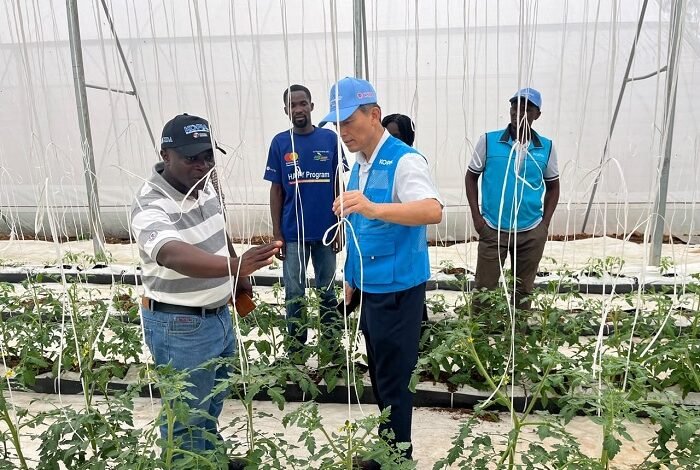
The Director of the Korea Programme on International Agriculture (KOPIA) Ghana, Dr Young-jin Kim, together with project management officials from the CSIR-Crops Research Institute (CSIR-CRI) and KOPIA administrative staff, has conducted a monitoring visit to climate-smart greenhouse tomato trial sites across the Ashanti Region.
Led by Dr Michael Kwabena Osei, Principal Research Scientist and Vegetable Breeder at CSIR-CRI, the delegation inspected trial facilities at the Kwame Nkrumah University of Science and Technology (KNUST), CSIR-CRI at Kwadaso, and the Akumadan Irrigation Site.
The evaluation forms part of an ongoing initiative funded by the Government of the Republic of Korea through KOPIA Ghana, aimed at testing newly developed tomato lines in partnership with WorldVeg.
The evaluated genotypes, comprising both inbred and open-pollinated lines, are showing promising early performance under greenhouse conditions.


Despite strong year-round demand, open-field tomato production in Ghana continues to face challenges, including low yields, poor fruit quality, heavy pest and disease pressure and narrow profit margins.
Climate-smart greenhouse technology offers a high-yielding and resilient alternative. However, its adoption remains constrained by inadequate technical training and limited access to affordable inputs.
To address these challenges, the project focuses on three main areas: testing high-yielding and disease-resistant tomato lines suited to greenhouse production; demonstrating improved greenhouse production techniques directly on farms; and training smallholder farmers in modern greenhouse management, post-harvest handling and commercial marketing.
Seven promising tomato lines are currently being evaluated at six strategic locations across the country.
In the Ashanti Region, trials are being conducted at the Akumadan Irrigation Site, CSIR-CRI Kwadaso and KNUST (Agri-Impact). Other trial locations include the University of Energy and Natural Resources (UENR) campus in Dormaa East in the Bono Region, the Sogakope Senior High School (SHS) campus in the Volta Region and the KOPIA Ghana Station in the Greater Accra Region.
A major milestone of the project is the deployment of non-hybrid tomato varieties to significantly reduce input costs for local growers.
“Most greenhouse tomatoes currently grown are expensive imported hybrids,” Dr Osei mentioned, adding that, “If these CSIR-CRI lines succeed, they will offer a cost-effective, locally produced alternative. This is vital for sustaining year-round production, improving farmers’ incomes and strengthening climate resilience.”
He said the development of locally adapted tomato varieties would help reduce farmers’ dependence on expensive imported seeds while contributing to a more sustainable and resilient tomato production sector.
The project team will continue to monitor crop performance, economic viability and environmental impacts as the trials progress at the various locations nationwide.
BY KINGSLEY HOPE, KUMASI
You can now read the *Ghanaian Times* and *The Spectator* newspapers digitally on [TimesNewsPlus](https://timesnewsplus.com/newspapers).
Follow our WhatsApp Channel now! https://whatsapp.com/channel/0029VbAjG7g3gvWajUAEX12Q