Years of financial mismanagement, outdated machinery, and operational inefficiencies have significantly weakened the market position of GIHOC Distilleries Company Limited.
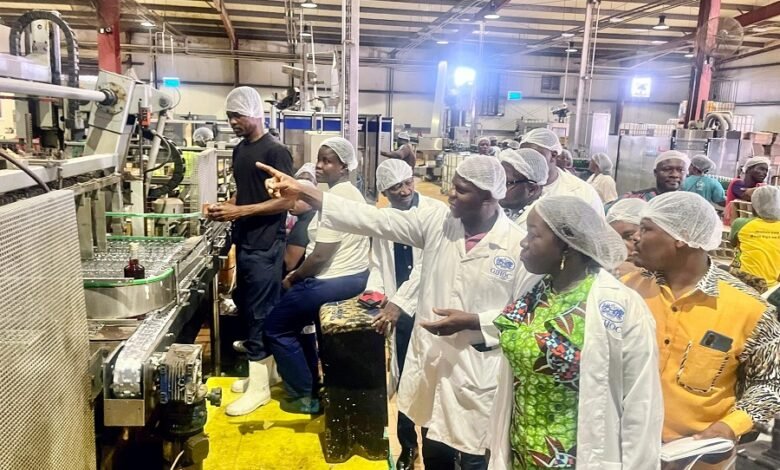
Despite an installed production capacity of 15,000 bottles per hour, outdated equipment—some dating as far back as 1968—has reduced output to just 2,000 bottles per hour, making it difficult for GIHOC to meet its market demand.
Acting Chief Executive Officer (CEO) of GIHOC, Jones Borteye Applerh, who made the revelation also added that the company had lost the trust of nearly all stakeholders, including creditors and suppliers.
He made these remarks when the Minister of Trade, Agribusiness, and Industry, Elizabeth Ofosu-Adjare, paid a working visit to the company in Accra on Friday. The visit formed part of her tour to assess the operations and challenges of key state institutions under her ministry’s jurisdiction.


“When we took over, we realised GIHOC had lost the trust of almost all stakeholders, including creditors and suppliers. The company was struggling to meet its financial obligations, and its products were often unavailable on the market,” he disclosed.
The challenges have led to a decline in GIHOC’s competitiveness, with its market shrinking every weekend due to the inability to keep up with consumer demand.
In response, the government, through the Minister, assured GIHOC of its commitment to revitalising the company, pledging financial support and investment in modern equipment in order to enhance its competitiveness.
“We are committed to supporting GIHOC to thrive. Efficiency is key, and we will ensure the company is retooled to maximise its potential under the 24-hour economy plan,” she stated.
Mrs Ofosu-Adjare, who also visited the Ghana Enterprises Agency (GEA) and the Ghana Free Zones Authority (GFZA), reiterated the government’s broader commitment to boosting industrial growth and attracting Foreign Direct Investment (FDI).
At the GFZA, she announced plans to transition Ghana’s Free Zones programme into Specialised Economic Zones to attract more investors and accelerate the country’s export development agenda.
She also emphasised the critical role of the authority in driving exports and assured stakeholders of new legislative measures to enhance competitiveness.
“But you know what? You are the engine that will make this thrive,” she told GFZA management and staff, urging them to uphold professionalism to retain investors.
The CEO of GFZA, Dr Mary Awusi, reaffrmed the agency’s commitment to supporting Ghana’s industrialisation drive.
“With your leadership and vision, we are confident you will play a key role in shaping Ghana’s trade and investment policies,” she noted.
At the GEA, the Minister underscored the agency’s crucial role in job creation, skills development, and business growth.
Moreover, she emphasised the need for strong leadership and teamwork to enhance its impact, stating, “Good leaders bring out the best in every team member. Everyone in an organisation matters, from management to security personnel to cleaners.”
She also announced plans to introduce performance contracts under President John Dramani Mahama’s leadership to enhance accountability and efficiency across agencies under the Ministry of Trade.
She, however, assured stakeholders of continued engagement to address challenges and enhance productivity across the trade and industry sector.
BY STEPHANIE BIRIKORANG