Governments, universities, businesses and communities across Africa have been urged to work together to harness nature-based solutions to address climate change, create jobs and advance sustainable development.
The call was made at a public lecture held under the theme: ‘Africa at a Crossroads: Can Nature-Based Solutions Deliver Climate Resilience, Jobs, Equity and Justice?’
The event brought together policymakers, researchers, students and development partners to explore how the continent could leverage its natural resources to build resilient economies.
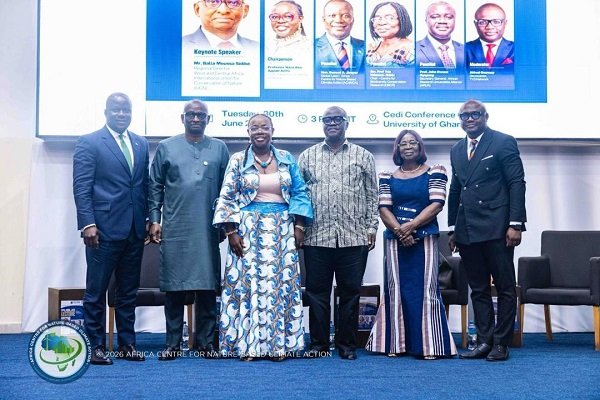
The lecture was organised by the University of Ghana’s Research and Innovation Directorate (RID) in collaboration with the Africa Centre for Nature-Based Climate Action (AC4NCA) to mark the 2026 Day of Scientific Renaissance of Africa (DSRA) at the Cedi Conference Centre on Tuesday.

Delivering the keynote address, the Regional Director for West and Central Africa of the International Union for Conservation of Nature (IUCN), Mr Balla Moussa Sidibé, indicated that Africa’s future would depend on protecting and restoring nature rather than exploiting it for short-term economic gains.
He noted that climate change had become a major development challenge, affecting agriculture, food security, water resources, livelihoods and economic growth across the continent.
Mr Sidibé explained that forests, wetlands, mangroves and healthy soils were critical assets which, if properly managed, could reduce climate risks, enhance food security and create sustainable employment opportunities.
He cited the Congo Basin as one of the world’s most vital ecosystems and stressed that its protection was crucial not only for Africa but for the global community due to its role in carbon storage, biodiversity conservation and rainfall regulation.
He therefore called for increased investment in ecosystem restoration, sustainable agriculture, ecotourism and other green sectors, particularly to create jobs for the youth.
During a panel discussion, the Member of Parliament for Damongo, Mr Samuel Abu Jinapor, stressed that research must go beyond academic publications to inform public policy and national development.
He explained that research should be linked to business and financing mechanisms to ensure that innovations were translated into practical solutions that delivered economic value.
Mr Jinapor further indicated that governments must demonstrate strong political will by establishing policies and regulatory frameworks that would enable African countries to benefit from the expanding global market for nature-based solutions.
He noted that Ghana had made strides in this direction by developing a national framework for carbon trading, which had created opportunities for communities to earn income from environmental conservation.
According to him, about five million dollars had already been distributed through a benefit-sharing arrangement under the country’s carbon market programme to support local communities and researchers.
The former Minister of Lands and Natural Resources, however, emphasised the need for stronger legislation to provide legal backing for existing policies and ensure their sustainability.
He also highlighted Ghana’s progress in responsible forest management, noting that the country, together with Indonesia, was among the first to issue Forest Law Enforcement, Governance and Trade (FLEGT) licences for legally sourced timber exports.
Mr Jinapor added that successive governments had continued to strengthen environmental policies and expand certified forest resources to meet international standards.
Other panellists called for deeper collaboration among universities, governments and research institutions across Africa, observing that many countries faced similar environmental challenges and should prioritise knowledge-sharing over working in isolation.
They emphasised that trust, transparency and fairness were essential for effective research partnerships and urged that the benefits of collaboration be shared equitably.
Touching on Monday’s floods in parts of Accra, the panellists indicated that years of wetland destruction and poor land-use planning had exacerbated flooding in the capital.
They explained that wetlands such as the Densu Delta and Sakumo Ramsar sites played a vital role in absorbing floodwaters and preserving biodiversity, but continued to suffer encroachment and degradation.
The Director of the Research and Innovation Directorate of the University of Ghana, Professor David Dodoo-Arhin, noted that the Day of Scientific Renaissance of Africa had become a key platform for promoting research, innovation and partnerships aimed at addressing the continent’s development challenges.
He urged stronger collaboration among industry, government and academia to ensure that research outcomes translated into practical solutions that improved livelihoods and supported sustainable development.
The speakers concluded by urging African countries to increase investment in nature, strengthen environmental legislation and transform research into actionable policies capable of building climate-resilient and inclusive economies for future generations.
By Enoch Ntiamoah Siaw
Follow our WhatsApp Channel now! https://whatsapp.com/channel/0029VbAjG7g3gvWajUAEX12Q