Reconciling Looming and Confrontations in the Silence We Carry
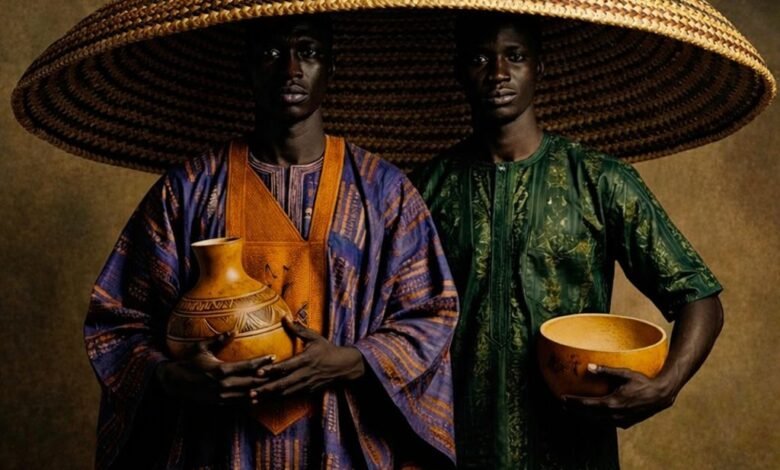
A large looming and unmistaken dome shaped object confronts the viewer first, then two identifiable young men beneath it and it’s hovering over them like a second sky.
The confrontational gaze of these men confronts the viewer next. Two confrontations at once and the viewer is forced into a pause. Take some steps back for some observatory look at the image again, this time taking in the elements one after the other and isolating the questions in their mind, maybe there would be answers.
This is what Samson Oriyomi Yusuf offers to the public in his exhibition titled The Silence We Carry at the Yenwa Gallery in Lagos held from July 9th – 14th in 2023.
This looming dome, was it supposed to be a hat? Did the weavers in their creativity build a hat for two instead of the usual one man hats? How did they envision movement under this dome? Is this a product of the artists’ imagination? Was it purpose built? To isolate those underneath as these men are now? The structure could have been a hat, shelter or even a granary. Though the scale appears deliberate it is questionable, large, almost impracticable and surreal. This suggests heritage in its magnified and monumentalised form.


The light faintly reflects on the figures faces, enough to appreciate their features eyes, nose and mouth, the ears are hidden. The same light affects their richly patterned garments with linear patterns. The two men each have a vessel in their hands, held closely in such a way that it signals treasure and delicateness.
The vessels are both calabash––a storage bowl derived from the fruit of a specie of melon––of varying shapes, one is narrow necked, with geometric inscriptions in brown colour, this is the type used for storage of liquid substances.
The other one is wide and opened bowl shaped used for serving and utilitarian purposes. Is the use of this varying shapes of calabash a metaphor or variety? The pairing becomes intentional, preservation in front of openness and accessibility, and their memory is held tightly.
The image refuses to move and that is very striking. The men are not caught in any act, no traditional performance. It appears they were commanded to remain under the covering of the dome. They are bearing tradition in their hands and wearing it.
There is a visually transmitted weight from beneath the dome, it is a dark almost unrecognisable aura touching down on their faces and bodies giving us a perception into how we interpret the men. Contouring the space, freezing the time and the weight appearing on their faces as burden, shelter and inheritance. The viewer begins to imagine what it cost these men to stand where they do now.
By Ozolua Uhakheme